Quotessence
Home / Authors / Leroy Chiao
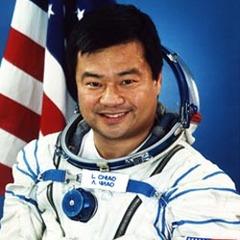
Leroy Chiao

Leroy Chiao Quotes

Engineer

Filter quotes by topic

Famous Leroy Chiao Quotes

“It was in the back of my mind, even while I was going to school, but it wasn't until I was at university studying engineering that I thought, well what do I really want to do? And I kind of came back to that and I said, well the degrees I'm trying to get are going to qualify me to apply. And so, that's what I did after I finished my, or after I was getting my doctorates. That's when I first applied to NASA.”

“Getting into a space suit and going outside, to me, getting your peripheral vision involved and looking at the Earth was a whole different experience than looking through the window. And it's kind of the same on earth. If you're driving in a car and you see like a beautiful sunset or landscape, it looks so much better if you stop and get out and kind of take it all in and that's kind of what it's like doing a spacewalk.”

“The space station mission was kind of the culmination of all of my experience of being a NASA Astronaut, so it had brought all of my previous experience into play. I had to learn the Russian language to a fluent level so that I could function as the co-pilot of the Soyuz Spacecraft that we flew up and back from the space station. And then the challenge of being the Commander of the whole expedition, a six and a-half month flight aboard the international space station. I felt the burden of the whole mission on my shoulders, which was fine, and fortunately everything did go well.”

“I grew up bilingual, I grew up speaking Chinese in the home, Mandarin Chinese with my parents, and I learned English because I was born and raised in the U.S. That really gave me an edge. I understand that, from the experts, if you grew up bilingual, your brain kind of gets wired to accept a new language. It was a very serious deal because not only did I have to learn Russian to a high degree in order to function as a necessary member of the crew, but also I knew that the Russians that came over that made an effort and had some success in learning English, those were the folks we trusted.”

“This was the first time we had two ex-Soviet Cosmonauts in Houston. A lot of us, including me, viewed it with some skepticism, because I grew up during the Cold War, so I had been hit with all this propaganda all along that their stuff wasn't that good, it wasn't that safe and we were so much better. What I found out later was that their space stuff was very good and good enough that I was certainly comfortable flying on their equipment. So, it was kind of a revelation of sorts as the years went by and I think it underscores the importance right now of international cooperation.”

“Because we didn't cooperate with China, we gave them motivation to develop their own capability. You know, they developed a very capable rocket system, very capable spacecraft. And if we don't cooperate with them in the future, they're going to develop more capable systems. If we're working together on a highly visible project, there is going to be much less, or there is going to be motivation for each country to not get into a conflict or any kind of tension in the military sense.”

“The Americans are still the leaders in human space flight. I feel we have a danger here of kind of stagnating. We're kind of resting on our laurels and there's a danger going forward if we don't take bold steps to really support human space flight in this country that we could fall behind. After the space shuttle is retired, we're going to have a big gap, five to seven years, at least where we're not going to have the ability to send our own astronauts into space, we'll have to buy rides on the Russian Soyuz, and so that will be a pretty big step down for us.”

“If we're not able to launch our own people and operate our own spacecraft anymore then, you know, space - whether it should be or not, it's seen as like a harbinger of technology. If you can fly people into space, if you can operate into space, then you've got high technology and if you're the leader of that, then you're the leader in technology. If we lose that on a more or less permanent basis, or for a long period of time, my fear is that it will creep into the national psyche in all areas and we as a nation as a whole will kind of be diminished.”

“Where we're operating is orbital adventures. We would offer five to seven days in low Earth orbit aboard our own spacecraft where customers would have the view of the Earth; get to experience really living in space, probably conducting some scientific investigations that we would piggyback onto those flights. So, they would have the whole experience, kind of a mini-experience of what professional astronauts have.”

“The expense of getting into space is the rocket launch, the rocket itself. Rocket's right now, commercial rockets cost probably somewhere between $50, or $120, or $150 million per launch. And those are all expendable. That is, you've got to buy a new rocket for each launch. So, that really is the critical part. If there was some kind of really, a revolutionary breakthrough and the price of rockets fell by an order of magnitude, I mean, just imagine what that would do as far as getting access to more ordinary people.”

“We have self-assessment tools, computer-based tools to see how we are performing mentally in outer space and there's some also very interesting technology and work that's being funded by NRSBI to look at facial recognition to look at your patterns to see if you're experiencing stress or fatigue. It's a kind of thing that I think will gain acceptance with gradually. But it probably has more to immediate application in things like homeland security, and looking at facial recognition of people going through airports and things like that to see who's under stress.”

“The Russians have been flying long duration crews since the early '70's. And in the early days, they've ended at least two missions early because of conflicts within the crew. So, they learned early on the importance of studying this and making sure you put the right crew together. Since we began our work together on the International Space station with the Russians in the early 2000's, NASA has started to learn the importance of this kind of work. And so, I think it's important work and we are not fully onboard and recognize it as important.”

“I remember getting advice like, "Oh, do what interests you. Don't worry about tomorrow, live for today," kind of thing. And to a degree, you've got to do that, you've got to follow your passions. You've got to follow your dreams, but you also have to have a plan. You can't just say I'm going to do what interests me today and I'm not going to worry about tomorrow, that doesn't work. And anyone who's tried that I think quickly finds that out. Think about what turns you on, what do you dream about? But along with that, make a plan and work hard to make it happen.”

“What keeps me up at night? Probably most, thinking about the future for my kids. It sounds kind of funny, but not so much what they're going to do, but how as a parent, how my wife and I as parents, how best we should prepare them for the world. And I know everybody does this, I think everybody stays up at night thinking about the best thing for their kids, and astronauts are no different.”

“My advice for an aspiring astronaut is to really follow your passion. I mean, study something that interests you, but also qualifies you to apply. NASA recruits from a wide variety of backgrounds. I know people who have applied to be an astronaut who ask me, well should I do this or should I do that. And I said, you know, it doesn't matter. The basic requirements are you have to be in good health, and you have to have a good heart, I mean in a technical way, not to be a kind person, well that helps. Study something that you like and do well in it.”