Quotessence
Home / Authors / Maria Montessori
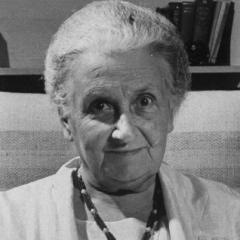
Maria Montessori

Maria Montessori Quotes

Physician

Filter quotes by topic

Famous Maria Montessori Quotes

“We teachers can only help the work going on, as servants wait upon a master. We then become witnesses to the development of the human soul; the emergence of the New Man who will no longer be the victim of events but, thanks to his clarity of vision, will become able to direct and to mold the future of mankind.”

“By the age of three, the child has already laid down the foundations of his personality as a human being, and only then does he need the help of special scholastic influences. So great are the conquests he has made that one may well say: the child who goes to school at three is already a little man.”

“Growth and psychic development are therefore guided by: the absorbent mind, the nebulae and the sensitive periods, with their respective mechanisms. It is these that are hereditary and characteristic of the human species. But the promise they hold can only be fulfilled through the experience of free activity conducted in the environment.”

“The aim of education should not be to teach how to use human energies to improve the environment, for we are finally beginning to realize that the cornerstone of education is the development of the human personality, and that in this regard education is of immediate importance for the salvation of mankind.”

“Times have changed, and science has made great progress, and so has our work; but our principles have only been confirmed, and along with them our conviction that mankind can hope for a solution to its problems, among which the most urgent are those of peace and unity, only by turning its attention and energies to the discovery of the child and to the development of the great potentialities of the human personality in the course of its formation.”

“...we discovered that education is not something which the teacher does, but that it is a natural process which develops spontaneously in the human being. It is not acquired by listening to words, but in virtue of experiences in which the child acts on his environment. The teacher's task is not to talk, but to prepare and arrange a series of motives for cultural activity in a special environment made for the child.”