Quotessence
Home / Authors / Maria Montessori
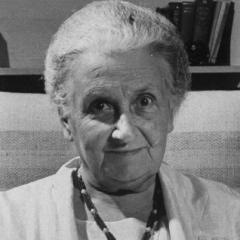
Maria Montessori

Maria Montessori Quotes

Physician

Filter quotes by topic

Famous Maria Montessori Quotes

“Freedom without organization of work would be useless. The child left free without means of work would go to waste, just as a new-born baby, if left free without nourishment, would die of starvation.The organization of the work, therefore, is the cornerstone of this new structure of goodness [in education], but even that organization would be in vain without the liberty to make use of it.”

“When the children had completed an absorbing bit of work, they appeared rested and deeply pleased. It almost seemed as if a road had opened up within their souls that led to all their latent powers, revealing the better part of themselves. They exhibited a great affability to everyone, put themselves out to help others and seemed full of good will.”

“If education recognizes the intrinsic value of the child's personality and provides an environment suited to spiritual growth, we have the revelation of an entirely new child whose astonishing characteristics can eventually contribute to the betterment of the world.”

“Children have an anxious concern for living beings, and the satisfaction of this instinct fills them with delight. It is therefore easy to interest them in taking care of plants and especially of animals. Nothing awakens foresight in a small child such as this. When he knows that animals have need of him, that little plants will dry up if he does not water them, he binds together with a new thread of love today's passing moments with those of the morrow.”

“The greatest sign of success for a teacher...is to be able to say, "The children are now working as if I did not exist."”

“If an educational act is to be efficacious, it will be only that one which tends to help toward the complete unfolding of life. To be thus helpful it is necessary rigorously to avoid the arrest of spontaneous movements and the imposition of arbitrary tasks.”

“The children are now working as if I did not exist.”

“Praise, help, or even a look, may be enough to interrupt him, or destroy the activity. It seems a strange thing to say, but this can happen even if the child merely becomes aware of being watched. After all, we too sometimes feel unable to go on working if someone comes to see what we are doing. The great principle which brings success to the teacher is this: as soon as concentration has begun, act as if the child does not exist. Naturally, one can see what he is doing with a quick glance, but without his being aware of it.”

“A child is an eager observer and is particularly attracted by the actions of the adults and wants to imitate them. In this regard an adult can have a kind of mission. He can be an inspiration for the child's actions, a kind of open book wherein a child can learn how to direct his own movements. But an adult, if he is to afford proper guidance, must always be calm and act slowly so that the child who is watching him can clearly see his actions in all their particulars.”

“But if for the physical life it is necessary to have the child exposed to the vivifying forces of nature, it is also necessary for his psychical life to place the soul of the child in contact with creation.”

“He who experiments must, while doing so, divest himself of every preconception. It is clear then that if we wish to make use of a method of experimental psychology, the first thing necessary is to renounce all former creeds and to proceed by means of the method in the search for truth.”

“No one can help us to achieve the intimate isolation by which we find our secret worlds, so mysterious, rich and full. If others intervene, it is destroyed. This degree of thought, which we attain by freeing ourselves from the external world, must be fed by the inner spirit, and our surroundings cannot influence us in any way other than to leave us in peace.”

“Beauty lies in harmony, not in contrast; and harmony is refinement; therefore, there must be a fineness of the senses if we are to appreciate harmony.”