Quotessence
Home / Authors / Maria Montessori
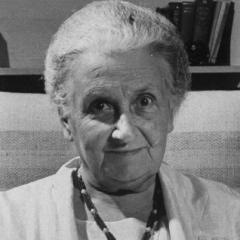
Maria Montessori

Maria Montessori Quotes

Physician

Filter quotes by topic

Famous Maria Montessori Quotes

“Children have an anxious concern for living beings, and the satisfaction of this instinct fills them with delight. It is therefore easy to interest them in taking care of plants and especially of animals. Nothing awakens foresight in a small child such as this. When he knows that animals have need of him, that little plants will dry up if he does not water them, he binds together with a new thread of love today's passing moments with those of the morrow.”

“The task of the educator lies in seeing that the child does not confound good with immobility, and evil with activity, as often happens in old-time discipline . . . A room in which all the children move about usefully, intelligently, and voluntarily, without committing any rough or rude act, would seem to me a classroom very well disciplined indeed.”

“The task of the educator lies in seeing that the child does not confound good with immobility and evil with activity.”

“By the age of three, the child has already laid down the foundations of his personality as a human being, and only then does he need the help of special scholastic influences. So great are the conquests he has made that one may well say: the child who goes to school at three is already a little man.”

“... the first thing his education demands is the provision of an environment in which he can develop the powers given him by nature. This does not mean just to amuse him and let him do what he likes. But it does mean that we have to adjust our minds to doing a work of collaboration with nature, to being obedient to one of her laws, the law which decrees that development comes from environmental experience.”

“When mental development is under discussion, there are many who say, 'How does movement come into it? We are talking about the mind.' And when we think of intellectual activity, we always imagine people sitting still, motionless. But mental development must be connected with movement and be dependent on it. It is vital that educational theory and practice should be informed by that idea.”

“Praise, help, or even a look, may be enough to interrupt him, or destroy the activity. It seems a strange thing to say, but this can happen even if the child merely becomes aware of being watched. After all, we too sometimes feel unable to go on working if someone comes to see what we are doing. The great principle which brings success to the teacher is this: as soon as concentration has begun, act as if the child does not exist. Naturally, one can see what he is doing with a quick glance, but without his being aware of it.”

“...we discovered that education is not something which the teacher does, but that it is a natural process which develops spontaneously in the human being. It is not acquired by listening to words, but in virtue of experiences in which the child acts on his environment. The teacher's task is not to talk, but to prepare and arrange a series of motives for cultural activity in a special environment made for the child.”