Quotessence
Home / Quotes / Quote by Maria Montessori

Quote by Maria Montessori

“Only when the child is able to identify its own center with the center of the universe does education really begin.”

Quote by Maria Montessori

Author
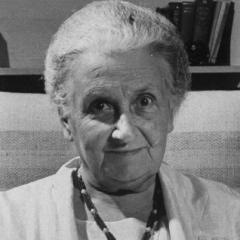
Maria Montessori
Maria Montessori

Maria Montessori, an Italian physician and educator, is known as the father of modern education. Born on August 31, 1870, in Ancona, Italy, she passed away on May 6, 1952. Dr. Montessori achieved remarkable success in the medical field, but she is most famous for her creation of the Montessori educational method, which emphasizes child-centered learning and individualized education. more

You May Also Like

“Educators, long disturbed by schoolchildren's lagging scores in math and reading, are realizing there is a different and more alarming deficiency: emotional literacy. And while laudable efforts are being made to raise academic standards, this new and troubling deficiency is not being addressed in the standard school curriculum. As one Brooklyn teacher put it, the present emphasis in schools suggests that "we care more about how well schoolchildren can read and write than whether they'll be alive next week."”

“These four policy prescriptions - strengthening educational opportunities, revamping immigration rules for highly skilled workers, increasing federal funding for basic scientific research, and providing incentives for private-sector R&D - should in my view be top priorities as Congress and the Administration consider how to maintain the nation's leadership in science, technology, and innovation.”

“I think the more you have a generalist perspective, I think sometimes the more you can kind of see through the forest and the trees. And when it gets a little bit cloudy, you know, have some sense of, "Well, maybe this might happen or maybe that might happen." So I really am a big believer in liberal arts education. I think it's better - particularly in these kind of uncertain times - to know a little bit about a lot of things as opposed to being expert in one thing.”

“Whatever new threats and challenges may emerge, our nation will be able to face them squarely, deal with them, and yet allow our people to continue to live free and unafraid. The decisions you make, the courage and creativity you bring to your responsibilities, will determine America's future. Liberty and our way of life are fragile gifts - their care is in your hands. We thank you for stepping forward to shoulder that immense responsibility. Your country is grateful, and proud of each of you.”

“Insofar as he makes use of his healthy senses, man himself is the best and most exact scientific instrument possible. The greatest misfortune of modern physics is that its experiments have been set apart from man, as it were, physics refuses to recognize nature in anything not shown by artificial instruments, and even uses this as a measure of its accomplishments.”

“In India there was a sense of time that does not tick with modern clocks, just as there is a knowledge that is not gained through science and empirical experiments. In the modern West knowledge is of objective, finite particulars in historical time. India recognizes that kind of useful information: it calls it "lower knowledge." Higher knowledge (paravidya) proceeds differently, or rather it doesn't proceed at all but enters history full-blown on the morning of a new creation.”

“The animate earth - this moody terrain that we experience differently in anger and in joy, in grief and in love - is both the soil in which all our sciences are rooted and the rich humus into which their results ultimately return, whether as nutrients or as poisons. Our spontaneous experience of the world, charged with subjective, emotional, and intuitive content, remains the vital and dark ground of all our objectivity”

“The belief in an external world independent of the perceiving subject is the basis of all natural science. Since, however, sense perception only gives information of this external world or of "physical reality" indirectly, we can only grasp the latter by speculative means. It follows from this that our notions of physical reality can never be final. We must always be ready to change these notions - that is to say, the axiomatic basis of physics - in order to do justice to perceived facts in the most perfect way.”