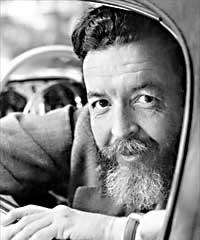
“I think Miss Moore was right to cut "The Steeple-Jack" - the poem seems plainer and clearer in its shortened state but she has cut too much... The reader may feel like saying, "Let her do as she pleases with the poem; it's hers, isn't it?" No; it's much too good a poem for that, it long ago became everybody's, and we can protest just as we could if Donatello cut off David's left leg.” IfsThinkingFeelsMayLongStatesSeemsLeftToo MuchCuttingMissingReaderPleaseLegsProtestLong AgoSteeplesDonatello Author:Randall Jarrell
“Goethe said, "The author whom a lexicon can keep up with is worth nothing"; Somerset Maugham says that the finest compliment he ever received was a letter in which one of his readers said: "I read your novel without having to look up a single word in the dictionary." These writers, plainly, lived in different worlds.” WorldLooksSaidDifferentNovelReaderLettersLook UpComplimentFinestDictionaryDifferent WorldsSingle WordLexicon Author:Randall Jarrell
“Robert Frost says in a piece of homely doggerel that he has hoped wisdom could be not only Attic but Laconic, Boeotian even - "at least not systematic"; but how systematically Frostian the worst of his later poems are! His good poems are the best refutation of, the most damning comment on, his bad: his Complete Poems have the air of being able to educate any faithful reader into tearing out a third of the pages, reading a third, and practically wearing out the rest.” AbleReadingPiecesAirWorstReaderPagesThirdsFaithfulCommentEducateSystematicFrostHaving HopeAtticsHomelyRefutationLaconic Author:Randall Jarrell
“There are some good things and some fantastic ones in Auden's early attitude; if the reader calls it a muddle I shall acquiesce, with the remark that the later position might be considered a more rarefied muddle. But poets rather specialize in muddles and I have no doubt which of the muddles was better for Auden's poetry: one was fertile and usable, the other decidedly is not. Auden sometimes seems to be saying with Henry Clay, "I had rather be right than poetry"; but I am not sure, then, that he is either.” IfsSometimesSeemsMightAttitudeDoubtPositionPoetReaderGood ThingsFantasticNot SureNo DoubtClayRemarksFertileMuddleAuden Author:Randall Jarrell
“Underneath all his writing there is the settled determination to use certain words, to take certain attitudes, to produce a certain atmosphere; what he is seeing or thinking or feeling has hardly any influence on the way he writes. The reader can reply, ironically, "That's what it means to have a style"; but few people have so much of one, or one so obdurate that you can say of it, "It is a style that no subject can change.” PeopleThinkingWayWritingMeanUseFeelingsCertainAttitudeSeeingInfluenceSubjectsStyleProduceReaderDeterminationAtmosphere Author:Randall Jarrell
“Few poets have made a more interesting rhetoric out of just fooling around: turning things upside down, looking at them from under the sofa, considering them (and their observer) curiously enough to make the reader protest, "That were to consider it too curiously.” MadeEnoughInterestingPoetReaderProtestRhetoricConsideringObserversUpside DownSofasFooling AroundThings Upside Down Author:Randall Jarrell
“Nowadays when a poet with one privately printed book can have his next three years taken care of by a Guggenheim fellowship, a Kenyon Review fellowship, and the Prix de Rome, it is hard to remember what chances the poet took in that small-town world, how precariously hand-to-mouth his existence was. And yet in one way the old days were better; [Vachel] Lindsay after a while, by luck and skill, got far more readers than any poet could get today.” WorldWayYearsBookHardHandsCareTodayRememberThreeNextChanceExistenceTakenPoetReaderSkillsMouthsTownsLuckOne WayReviewsRomeThree YearsSmall TownFellowshipPrintedOld DaysLuck And SkillPrinted Books Author:Randall Jarrell
“More and more people think of the critic as an indispensable middle man between writer and reader, and would no more read a book alone, if they could help it, than have a baby alone.” PeopleIfsThinkingMenBookHelpingMiddleBabyReaderCriticsIndispensable Author:Randall Jarrell