Quotessence
Home / Authors / Russell Banks Books
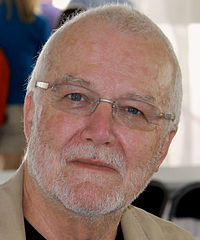
Russell Banks

Russell Banks Books

Writer

Cloudsplitter

A source page for quotes linked to Russell Banks.
0 quotes

Trailerpark

A source page for quotes linked to Russell Banks.

0 quotes

Success stories

A source page for quotes linked to Russell Banks.

0 quotes

Related Quotes

“But so much of a man's life is merely a matter of choice, the declared—the right choice, the wrong choice. And even if a man makes the wrong choice, he can still change it. He simply has to change his mind. "You're a man, Owen, aren't you? And, really, when you have good health, you men are your minds. You can become a man of action, if you want. Or of religion. Or both. You may not end up famous for it, like your beloved father, but you can be it. Tell me Owen, isn't that how it is?" She stared grimly down at the black waves and clenched the rail with both hands.”

“Her family members and their friends and associates were, for the most part, rigorous Unitarians and well-known Transcendentalists. But for all their liberalism in religion, in terms of their public and private behavior they were still old-fashioned, upright Puritans. 'In other words, they are good people,' she said. 'Morally upright.' Their generation had abandoned the Calvinist theology in their youth, but had kept the morality. She, on the other hand, having been encouraged by her elders since her nursery days to forsake the old Puritan forms of religion, had retained none of the Puritans' moral uprightness and rigor. She was a sinner, she said. A sinner without the comfort of prayer and with no possibility of redemption.”

“I suppose some things seem obscure, Mister Brown, but really, they're quite obvious, aren't they?' said Mr. Forbes. 'Once they've been pointed out, of course. Either by genius before the fact, or, as is more often the case, after the fact by disaster. Don't you think so?...For instance, Mr. Brown, here's some after-the-fact wisdom, if you like. Taken from the Italian campaign. Taught by disaster.' The smaller force, he said, had of necessity always to be made of men who, though they believed many things, must believe but two. Number one, each soldier must believe that he is engaged in a struggle in which he and his comrades are morally right and their opposition is morally wrong. No middle way. No room to negotiate a compromise. It couldn't be a simple dispute over land. Basic principles, not mere borders, must be at stake. And number two, he must believe that he is fighting for his own life and for the lives of his loved ones. So that the only imaginable alternative to his participating in this dreadful war is death for him and his loved ones. No going home for a season to harvest the olives and the grapes.”

“Those who stayed on and endured our hardship and deprivation and the almost daily risk to our lives were of necessity physically hardy fellows, but they were also the most courageous men out there then and the most dedicated to the anti-slavery cause. Father would have said it was because they were dedicated to the anti-slavery cause. 'It's a mistake,' he told me, 'to that that bullies make the best fighters, or that violent, cruel men would be fitter to oppose the Southerners than our mild, abolitionist Christians. Give me men of good principles, God-fearing men, men who respect themselves and each other, and with a dozen of them I'll oppose any hundred of such men as these Border Ruffians!”

“Every morning, before beginning our day's labor, we gathered together in the parlor for prayers and Father's brief sermon, and even though I had grown long used to these solemn services, they nevertheless uplifted me, as I believe they did the others, and made the day's work easier, for despite my unbelief, the services connected our labor to something larger than ourselves and our petty daily needs. Father's intention, I am sure, was precisely that–to lead us to understand our woodcutting and plowing and constant care of animals, the day-long manufacture of our meals and the permanent ongoing repair of our tools and equipment, and our endless preparation for the long winter, such that we would believe that we were participating in a great cycle of life, as if we were tiny arcs of an enormous curve, a universal template that began with birth and ended with death and which, if participated in fully and without shirking, would lead us to a second and still larger cycle of rebirth and regeneration, to an infinite spiral, as it were. Thus, as the fields were prepared and sown, so too were our inner lives being prepared and sown, and as our land and our livestock grew fruitful and multiplied, so did our spirits blossom and bear fruit, and as we dried and salted and stored our food and supplies in sawdust and hay for winter, so would our spirits and minds be prepared to endure the inescapable suffering and deaths of our loved ones, which would come to us as inevitably as the freezing winds and the deep, drifting snows of winter.”

“If we had learned anything over the last decade, it was that there was no other way to defeat slavery, except with a willingness to die for it. We had learned what the Negroes long knew. And thus we merely did what the Negroes themselves had done over and over in the past—in Haiti, in the mountains of Jamaica, and in the swamps of Virginia—but could not do out there on the plains of Kansas. We did what we wanted the Negroes to do in Kansas. By slaying those five pro-slavers on the Pottawatomie that night, we placed hundreds, thousands, of other white men in the same position that we along amongst the whites had held for years: for now every white man in Kansas, anti-slaver and pro-slaver alike, had to be ready to die for his cause.”

“When an old man and a young man work together, it can make an ugly sight or a pretty one, depending on who's in charge. If the young man's in charge or won't let the old man take over, the young man's brute strength becomes destructive and inefficient, and the old man's intelligence, out of frustration, grows cruel and inefficient. Sometimes the old man forgets that he is old and tries to compete with the young man's strength, and then it's a sad sight. Or the young man forgets that he is young and argues with the old man about how to do the work, and that's a sad sight, too.”

“The issue of torture, connected to American soldiers, is not somewhere most people want to linger. We may not want to confront this issue so much in the U.S. because of how we want to think about our veterans. There's the sense that we want to think of our veterans as - if they're damaged, damaged by something glamorous, like a firefight.”

“I am aware of the changes, but in no sense am I believer that we live in a post-racial society. That's a description of our inheritance and that is theirs, which is inescapable. It is doesn't matter if you are from New England or Mississippi. You're an American. It doesn't matter if you are white, black, brown, or Asian. It is part of American society. You'd have to be blind, deaf, or dumb not to know it. The emphasis on color or the fear of it, is all part of the same dark flower. I am trying to point to that and to bring it all the way back from Senegal.”

“They were gone and I missed them but even so I was very happy. For the rest of my life no matter where on this planet earth I went and no matter how scared or confused I got, I could wait until dark and look up into the night sky and see my three friends again and my heart would swell with love of them and make me strong and clearheaded.”

“It was strange to stand there in front of the mirror and see myself like I was my own best friend, a kid wanted to hang with forever. This was a boy I could travel to the seacoasts with, a boy I'd like to meet up with in foreign cities like Calcutta and London and Brazil, a boy I could trust who also had a good sense of humor and liked smoked oysters from a can and good weed and the occasional 40 ounces of malt. If I was going to be alone for the rest of my life this was the person I wanted to be alone with.”

“What you believe matters, however. It’s all anyone has to act on. And since what you do is who you are, your actions define you. If you don’t believe anything is true simply because you can’t logically prove what’s true, you won’t do anything. You won’t be anything. You’ll end up spending your life in a rocking chair looking out at the horizon waiting for an answer that never comes. You might as well be dead. It’s an old philosophical problem.”