Quotessence
Home / Authors / Thomas Paine
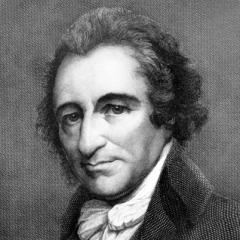
Thomas Paine

Thomas Paine Quotes

Author

Filter quotes by topic

Famous Thomas Paine Quotes

“Prejudice, like the spider, makes everywhere its home. It has neither taste nor choice of place, and all that it requires is room. If the one prepares her food by poisoning it to her palate and her use, the other does the same. Prejudice may be denominated the spider of the mind.”

“The continual whine of lamenting the burden of taxes, however successfully it may be practiced in mixed governments, is inconsistent with the sense and spirit of a republic. If taxes are necessary, they are of course advantageous, but if they require an apology, the apology itself implies an impeachment. Why, then, is man imposed upon, or why does he impose upon himself?”

“America could carry on a two years' war by the confiscation of the property of disaffected persons, and be made happy by their expulsion. Say not that this is revenge, call it rather the soft resentment of a suffering people, who, having no object in view but the good of all, have staked their own all upon a seemingly doubtful event. Yet it is folly to argue against determined hardness; eloquence may strike the ear, and the language of sorrow draw forth the tear of compassion, but nothing can reach the heart that is steeled with prejudice.”

“All the religions known in the world are founded, so far as they relate to man or the unity of man, as being all of one degree. Whether in heaven or in hell, or in whatever state man may be supposed to exist hereafter, the good and the bad are the only distinctions.”

“Revelation is necessarily limited to the first communication- after that it is only an account of something which that person says was a revelation made to him; and though he may find himself obliged to believe it, it can not be incumbent on me to believe it in the same manner; for it was not a revelation made to ME, and I have only his word for it that it was made to him.”

“They may be all comprehended under three heads - 1st, Superstition; 2d, Power; 3d, the common interests of society, and the common rights of man.”

“But there are times when men have serious thoughts, and it is at such times, when they begin to think, that they begin to doubt the truth of the Christian religion; and well they may, for it is too fanciful and too full of conjecture, inconsistency, improbability and irrationality, to afford consolation to the thoughtful man. His reason revolts against his creed. He sees that none of its articles are proved, or can be proved.”

“It may perhaps be said that it signifies nothing to a man what is done to him after he is dead; but it signifies much to the living; it either tortures their feelings or hardens their hearts.”

“Infidelity does not consist in believing, or in disbelieving; it consists in professing to believe what he does not believe. It is impossible to calculate the moral mischief, if I may so express it, that mental lying has produced in society. When a man has so far corrupted and prostituted the chastity of his mind, as to subscribe his professional belief to things he does not believe, he has prepared himself for the commission of every other crime.”

“When it shall be said in any country in the world my poor are happy; neither ignorance nor distress is to be found among them; my jails are empty of prisoners, my streets of beggars; the aged are not in want; the taxes are not oppressive; the rational world is my friend, because I am a friend of its happiness: When these things can be said, there may that country boast its Constitution and its Government”

“Let it be told to the future world, that in the depth of winter, when nothing but hope and virtue could survive, that the city and the country, alarmed at one common danger, came forth to meet and to repulse it. Say not that thousands are gone, turn out your tens of thousands; throw not the burden of the day upon Providence, but "show your faith by your works," that God may bless you. It matters not where you live, or what rank of life you hold, the evil or the blessing will reach you all.”

“Ignorance is of a peculiar nature; once dispelled, it is impossible to reestablish it. It is not originally a thing of itself, but is only the absence of knowledge; and though man may be kept ignorant, he cannot be made ignorant.”

“It is never to be expected in a revolution that every man is to change his opinion at the same moment. There never yet was any truth or any principle so irresistibly obvious that all men believed it at once. Time and reason must cooperate with each other to the final establishment of any principle; and therefore those who may happen to be first convinced have not a right to persecute others, on whom conviction operates more slowly. The moral principle of revolutions is to instruct, not to destroy.”

“As parents, we can have no joy, knowing that this government is not sufficiently lasting to ensure any thing which we may bequeath to posterity: And by a plain method of argument, as we are running the next generation into debt, we ought to do the work of it, otherwise we use them meanly and pitifully. In order to discover the line of our duty rightly, we should take our children in our hand, and fix our station a few years farther into life; that eminence will present a prospect, which a few present fears and prejudices conceal from our sight.”

“I have never made it a consideration whether the subject was popular or unpopular, but whether it was right or wrong; for that which is right will become popular, and that which is wrong, though by mistake it may obtain the cry or fashion of the day, will soon lose the power of delusion, and sink into disesteem.”

“The earth, in its natural, uncultivated state was, and ever would have continued to be, the common property of the human race." As the land gets cultivated, "it is the value of the improvement, only, and not the earth itself, that is in individual property. Every proprietor, therefore, of cultivated lands, owes to the community a ground-rent..to every person, rich or poor...because it is in lieu of the natural inheritance, which, as a right, belongs to every man, over and above the property he may have created, or inherited from those who did”

“These proceedings may at first seem strange and difficult, but like all other steps which we have already passed over, will in a little time become familiar and agreeable: and until an independence is declared, the Continent will feel itself like a man who continues putting off some unpleasant business from day to day, yet knows it must be done, hates to set about it, wishes it over, and is continually haunted with the thoughts of its necessity.”

“The circumstances of the world are continually changing, and the opinions of men change also; and as government is for the living, and not for the dead, it is the living only that has any right in it. That which may be thought right and found convenient in one age, may be thought wrong and found inconvenient in another. In such cases, who is to decide, the living, or the dead?”