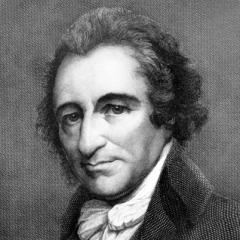
“The Christian theory is little else than the idolatry of the ancient mythologists, accommodated to the purposes of power and revenue; and it yet remains to reason and philosophy to abolish the amphibious fraud.”
Source: The age of reason
“That which is now called natural philosophy, embracing the whole circle of science, of which astronomy occupies the chief place, is the study of the works of God, and of the power and wisdom of God in his works, and is the true theology.
As to the theology that is now studied in its place, it is the study of human opinions and of human fancies concerning God. It is not the study of God himself in the works that he has made, but in the works or writings that man has made; and it is not among the least of the mischiefs that the Christian system has done to the world, that it has abandoned the original and beautiful system of theology, like a beautiful innocent, to distress and reproach, to make room for the hag of superstition.”
Source: The age of reason
“If I owe a person money, and cannot pay him, and he threatens to put me in prison, another person can take the debt upon himself, and pay it for me. But if I have committed a crime, every circumstance of the case is changed. Moral justice cannot take the innocent for the guilty even if the innocent would offer itself. To suppose justice to do this, is to destroy the principles of its existence, which is the thing itself. It is then no longer justice. It is indiscriminate revenge.
This single reflection will show that the doctrine of redemption is founded on a mere pecuniary idea corresponding to that of a debt which another person might pay; and as this pecuniary idea corresponds again with the system of second redemptions, obtained through the means of money given to the church for pardons, the probability is that the same persons fabricated both the one and the other of those theories; and that, in truth, there is no such thing as redemption; that it is fabulous; and that man stands in the same relative condition with his Maker he ever did stand, since man existed; and that it is his greatest consolation to think so.
Let him believe this, and he will live more consistently and morally, than by any other system. It is by his being taught to contemplate himself as an out-law, as an out-cast, as a beggar, as a mumper, as one thrown as it were on a dunghill, at an immense distance from his Creator, and who must make his approaches by creeping, and cringing to intermediate beings, that he conceives either a contemptuous disregard for everything under the name of religion, or becomes indifferent, or turns what he calls devout. In the latter case, he consumes his life in grief, or the affection of it. His prayers are reproaches. His humility is ingratitude. He calls himself a worm, and the fertile earth a dunghill; and all the blessings of life by the thankless name of vanities. He despises the choicest gift of God to man, the GIFT OF REASON; and having endeavored to force upon himself the belief of a system against which reason revolts, he ungratefully calls it human reason, as if man could give reason to himself.
Yet, with all this strange appearance of humility, and this contempt for human reason, he ventures into the boldest presumptions. He finds fault with everything. His selfishness is never satisfied; his ingratitude is never at an end. He takes on himself to direct the Almighty what to do, even in the government of the universe. He prays dictatorially. When it is sunshine, he prays for rain, and when it is rain, he prays for sunshine. He follows the same idea in everything that he prays for; for what is the amount of all his prayers, but an attempt to make the Almighty change his mind, and act otherwise than he does? It is as if he were to say - thou knowest not so well as I.”
Source: The age of reason
“if every one is left to judge of his own religion, there is no such thing as a religion that is wrong; but if they are to judge of each other’s religion, there is no such thing as a religion that is right; and therefore all the world is right, or all the world is wrong.”
Source: Rights of Man
“I bring reason to your ears, and, in language as plain as ABC, hold up truth to your eyes.”
Source: Paine: Political Writings
“All this [Paul's writing] is nothing better than the jargon of a conjurer who picks up phrases he does not understand to confound the credulous people who come to have their fortune told. Age of Reason”
“It is from our enemies that we often gain excellent maxims, and are frequently surprised into reason by their mistakes.”
Source: The Thomas Paine Collection: Common Sense, Rights of Man, Age of Reason, An Essay on Dream, Biblical Blasphemy, Examination Of The Prophecies
“The first was a government of priestcraft, the second of conquerors, and the third of reason.”
Source: The Political Writings of Thomas Paine ...: Prospects on the Rubicon. Rights of man, part I. Rights of man, part II. Letter to the authors of the Republican. Letter to the Abbe Sieyes. Address to the addressers. Letters to Lord Onslow. Dissertation on the first principles of government. Speech delivered in the French National convention. Letter to Mr. Secretary Dundas. The decline and fall of the English system of finance. Letter to the people of France. Reasons for preserving the life of Louis
“...Thomas did not believe the resurrection [John 20:25], and, as they say, would not believe without having ocular and manual demonstration himself. So neither will I, and the reason is equally as good for me, and for every other person, as for Thomas.”
“In Deism our reason and our belief become happily united. The wonderful structure of the universe, and everything we behold in the system of the creation, prove to us, far better than books can do, the existence of a God, and at the same time proclaim His attributes.”
Source: The Complete Writings of Thomas Paine
“It is often said in the Bible that God spake unto Moses, but how do you know that God spake unto Moses? Because, you will say, the Bible says so. The Koran says, that God spake unto Mahomet, do you believe that too? No. Why not? Because, you will say, you do not believe it; and so because you do, and because you don't is all the reason you can give for believing or disbelieving except that you will say that Mahomet was an impostor. And how do you know Moses was not an impostor?”
Source: The Theological Works of Thomas Paine: To which are Added the Profession of Faith of a Savoyard Vicar
“I fear not, I see not reason for fear. In the end we will be the victors. For though at times the flame of liberty may cease to shine, the ember will never expire.”
“But there are times when men have serious thoughts, and it is at such times, when they begin to think, that they begin to doubt the truth of the Christian religion; and well they may, for it is too fanciful and too full of conjecture, inconsistency, improbability and irrationality, to afford consolation to the thoughtful man. His reason revolts against his creed. He sees that none of its articles are proved, or can be proved.”
Source: The Works of Thomas Paine: A Hero in the American Revolution. With an Account of His Life ...
“It is only by the exercise of reason that man can discover God.”
Source: THE AGE OF REASON - Investigation of True and Fabulous Theology (Including
“What more does man want to know than that the hand or power that made these things is divine, is omnipotent? Let him believe this with the force it is impossible to repel, if he permits his reason to act, and his rule of moral life will follow of course.”
Source: The Thomas Paine Collection: Common Sense, Rights of Man, Age of Reason, An Essay on Dream, Biblical Blasphemy, Examination Of The Prophecies
“Before anything can be reasoned upon to a conclusion, certain facts, principles, or data, to reason from, must be established, admitted, or denied.”
Source: The Thomas Paine Collection: Common Sense, Rights of Man, Age of Reason, An Essay on Dream, Biblical Blasphemy, Examination Of The Prophecies
“The error of those who reason by precedents drawn from antiquity, respecting the rights of man, is that they do not go far enough into antiquity.”
Source: Rights of Man
“I would give worlds, if I had them, if The Age of Reason had never been published. O Lord, help! Stay with me! It is hell to be left alone.”
“Reason obeys itself; and ignorance submits to whatever is dictated to it.”
Source: THOMAS PAINE Ultimate Collection: Political Works, Philosophical Writings, Speeches, Letters & Biography (Including Common Sense, The Rights of Man & The Age of Reason): The American Crisis, The Constitution of 1795, Declaration of Rights, Agrarian Justice, The Republican Proclamation, Anti-Monarchal Essay, Letters to Thomas Jefferson and George Washington…
“Time makes more converts than reason.”
Source: Citizen Paine: Thomas Paine's Thoughts on Man, Government, Society, and Religion
“The most formidable weapon against errors of every kind is reason.”
Source: The Age of Reason: Being an Investigation of True and Fabulous Theology
“He that rebels against reason is a real rebel, but he that in defence of reason rebels against tyranny has a better title to Defender of the Faith, than George the Third.”
Source: THOMAS PAINE Ultimate Collection: Political Works, Philosophical Writings, Speeches, Letters & Biography (Including Common Sense, The Rights of Man & The Age of Reason): The American Crisis, The Constitution of 1795, Declaration of Rights, Agrarian Justice, The Republican Proclamation, Anti-Monarchal Essay, Letters to Thomas Jefferson and George Washington…
“We can only reason from what is; we can reason on actualities, but not on possibilities.”
“To argue with a man who has renounced the use and authority of reason, and whose philosophy consists in holding humanity in contempt, is like administering medicine to the dead, or endeavoring to convert an atheist by scripture.”
Source: Common Sense, The Rights of Man and Other Essential Writings of ThomasPaine
“A long habit of not thinking a thing wrong, gives it a superficial appearance of being right, and raises at first a formidable outcry in defense of custom. But the tumult soon subsides. Time makes more converts than reason.”
Source: Annotated Common Sense with English Grammar Exercises: by Thomas Paine (Author), Robert Powell (Editor)
“Of all the systems of religion that ever were invented, there is no more derogatory to the Almighty, more unedifying to man, more repugnant to reason, and more contradictory to itself than this thing called Christianity. Too absurd for belief, too impossible to convince, and too inconsistent for practice, it renders the heart torpid or produces only atheists or fanatics. As an engine of power, it serves the purpose of despotism, and as a means of wealth, the avarice of priests, but so far as respects the good of man in general it leads to nothing here or hereafter.”
“To reason with goverments, as they have existed for ages, is to argue with brutes. It is only from the nations themselves that reforms can be expected”
Source: THOMAS PAINE Ultimate Collection: Political Works, Philosophical Writings, Speeches, Letters & Biography (Including Common Sense, The Rights of Man & The Age of Reason): The American Crisis, The Constitution of 1795, Declaration of Rights, Agrarian Justice, The Republican Proclamation, Anti-Monarchal Essay, Letters to Thomas Jefferson and George Washington…
“Is it more probable that nature should go out of her course, or that a man should tell a lie? We have never seen, in our time, nature go out of her course; but we have good reason to believe that millions of lies have been told in the same time.”
“To argue with a person who has renounced the use of reason is like administering medicine to the dead.”
“It is never to be expected in a revolution that every man is to change his opinion at the same moment. There never yet was any truth or any principle so irresistibly obvious that all men believed it at once. Time and reason must cooperate with each other to the final establishment of any principle; and therefore those who may happen to be first convinced have not a right to persecute others, on whom conviction operates more slowly. The moral principle of revolutions is to instruct, not to destroy.”
Source: Dissertation on First-principles of Government
“Freedom had been hunted round the globe; reason was considered as rebellion; and the slavery of fear had made men afraid to think. But such is the irresistible nature of truth, that all it asks, and all it wants, is the liberty of appearing.”
Source: Paine: Political Writings
“In the following pages I offer nothing more than simple facts, plain arguments, and common sense; and have no other preliminaries to settle with the reader, than that he will divest himself of prejudice and repossession, and suffer his reason and feelings to determine for themselves; and that he will put on, or rather that he will not put off, the true character of man, and generously enlarge his view beyond the present day.”
“The prejudice of unfounded belief often degenerates into the prejudice of custom, and becomes at last rank hypocrisy. When men, from custom or fashion or any worldly motive, profess or pretend to believe what they do not believe, nor can give any reason for believing, they unship the helm of their morality, and being no longer honest to their own minds they feel no moral difficulty in being unjust to others.”
Source: The Age of Reason, etc
“But there is another and greater distinction for which no truly natural or religious reason can be assigned, and that is the distinction of men into kings and subjects. Male and female are the distinctions of nature, good and bad the distinctions of heaven; but how a race of men came into the world so exalted above the rest, and distinguished like some new species, is worth inquiring into, and whether they are the means of happiness or of misery to mankind.”
“Of all the systems of religion that ever were invented, there is no more derogatory to the Almighty, more unedifiying to man, more repugnant to reason, and more contradictory to itself than this thing called Christianity.”
“As to the Christian system of faith, it appears to me as a species of Atheism — a sort of religious denial of God. It professes to believe in a man rather than in God. It is a compound made up chiefly of Manism with but little Deism, and is as near to Atheism as twilight is to darkness. It introduces between man and his Maker an opaque body, which it calls a Redeemer, as the moon introduces her opaque self between the earth and the sun, and it produces by this means a religious, or an irreligious, eclipse of light. It has put the whole orbit of reason into shade.”
Source: THE AGE OF REASON - Investigation of True and Fabulous Theology (Including
“The choicest gift of God to man, the gift of reason; and having endeavoured to force upon himself the belief of a system against which reason revolts, he ungratefully calls it human reason; as if man could give reason to himself.”
“There is a happiness in Deism, when rightly understood, that is not to be found inany other system of religion. All other systems have something in them that either shock our reason, or are repugnant to it, and man, if he thinks at all, must stifle his reason in order to force himself to believe them.”
Source: The Theological Works of Thomas Paine: To which are Added the Profession of Faith of a Savoyard Vicar
“Reason and Ignorance, the opposites of each other, influence the great bulk of mankind. If either of these can be rendered sufficiently extensive in a country, the machinery of Government goes easily on. Reason obeys itself; and Ignorance submits to whatever is dictated to it.”
Source: Rights of Man: Being an Answer to Mr. Burke's Attack on the French Revolution
“When an objection cannot be made formidable, there is some policy in trying to make it frightful; and to substitute the yell and the war-whoop, in the place of reason, argument and good order.”
Source: The Complete Writings of Thomas Paine
“In Deism our reason and our belief are happily united.”