Quotessence
Home / Quotes / Quote by Francis Galton

Quote by Francis Galton

“Exercising the right of occasional suppression and slight modification, it is truly absurd to see how plastic a limited number of observations become, in the hands of men with preconceived ideas.”

Quote by Francis Galton

Author
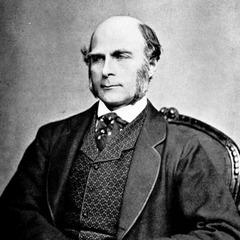
Francis Galton
Francis Galton

Francis Galton was a British polymath known for his work in statistics, anthropology, eugenics, and psychology. He was the half-cousin of Charles Darwin and is often credited with coining the term 'eugenics'. Galton's contributions to the field of statistics include the development of regression analysis and the application of correlation. He also conducted extensive research on heredity and intelligence, which influenced later theories in these areas. more

You May Also Like

“I am convinced that this is the only means of advancing science, of clearing the mind from a confused heap of contradictory observations, that do but perplex and puzzle the Student, when he compares them, or misguide him if he gives himself up to their authority; but bringing them under one general head, can alone give rest and satisfaction to an inquisitive mind.”

“I cannot but be astonished that Sarsi should persist in trying to prove by means of witnesses something that I may see for myself at any time by means of experiment. Witnesses are examined in doutbful matters which are past and transient, not in those which are actual and present. A judge must seek by means of witnesses to determine whether Peter injured John last night, but not whether John was injured, since the judge can see that for himself.”

“I picture the vast realm of the sciences as an immense landscape scattered with patches of dark and light. The goal towards which we must work is either to extend the boundaries of the patches of light, or to increase their number. One of these tasks falls to the creative genius; the other requires a sort of sagacity combined with perfectionism.”

“I would by all means have men beware, lest Æsop's pretty fable of the fly that sate [sic] on the pole of a chariot at the Olympic races and said, 'What a dust do I raise,' be verified in them. For so it is that some small observation, and that disturbed sometimes by the instrument, sometimes by the eye, sometimes by the calculation, and which may be owing to some real change in the heaven, raises new heavens and new spheres and circles.”

“If we range through the whole territory of nature, and endeavour to extract from each department the rich stores of knowledge and pleasure they respectively contain, we shall not find a more refined or purer source of amusement, or a more interesting and unfailing subject for recreation, than that which the observation and examination of the structure, affinities, and habits of plants and vegetables, afford.”

“In fact, we will have to give up taking things for granted, even the apparently simple things. We have to learn to understand nature and not merely to observe it and endure what it imposes on us. Stupidity, from being an amiable individual defect, has become a social crime.”