“Hegel remarks somewhere that all great, world-historical facts and personages occur, as it were, twice. He has forgotten to add: the first time as tragedy, the second as farce.”
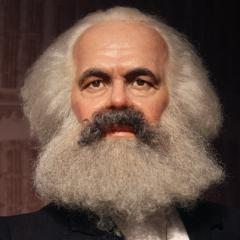
Quote by Karl Marx
Work
The Eighteenth Brumaire of Louis Bonaparte
This work examines the political and social circumstances surrounding the coup of 18 Brumaire (December 2, 1851), in which Louis-Napoléon Bonaparte, nephew of Napoleon I, dissolved the French National Assembly and seized dictatorial power. The text explores the interplay of class struggles, state power, and historical repetition, famously noting that great events occur twice: first as tragedy, then as farce. It provides a critical perspective on the rise of authoritarianism within a democratic framework, focusing on the role of the peasantry, the bourgeoisie, and the proletariat in shaping political outcomes. The analysis is grounded in the specific events of mid-19th century France, offering insights into the mechanics of political manipulation and the fragility of republican institutions. more
Author
You May Also Like
Source: The Communist Manifesto and Its Relevance for Today
Source: Karl Marx, Frederick Engels: Collected Works
“The existence of the state is inseparable from the existence of slavery.”
Source: Selected essays
Source: Free Trade: A Speech Delivered Before the Democratic Club, Brussels, Belgium, Jan. 9, 1848. With Extract from La Misère de la Philosophie
Source: Capital, Volume I: A Critique of Political Economy
Source: The Communist Manifesto: A Road Map to History's Most Important Political Document
Source: The Karl Marx Library: On the First International
Source: Delphi Collected Works of Karl Marx (Illustrated)