Quotessence
Home / Quotes / Quote by Steven Weinberg

Quote by Steven Weinberg

“It was one time when people thought the value of the fine structure constant was important. Now of course it's still important, of course, as a practical matter,but we now know that the value it has is a function, that in any fundamental theory you derive the fine structure constant as a function of all sorts of mass ratios and so on and it's not really that fundamental.”

Quote by Steven Weinberg

Author
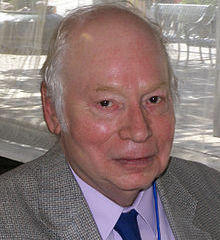
Steven Weinberg
Steven Weinberg

Steven Weinberg is a renowned theoretical physicist known for his contributions to particle physics and cosmology. In 1967, he was awarded the Nobel Prize in Physics, along with Abdus Salam and Sheldon Glashow, for their work on the unification of the weak interaction. more

You May Also Like

“Indeed Christianity passes. Passes - it has gone! It has littered the beaches of life with churches, cathedrals, shrines and crucifixes, prejudices and intolerances, like the sea urchin and starfish and empty shells and lumps of stinging jelly upon the sands here after a tide. A tidal wave out of Egypt. And it has left a multitude of little wriggling theologians and confessors and apologists hopping and burrowing in the warm nutritious sand. But in the hearts of living men, what remains of it now? Doubtful scraps of Arianism. Phrases. Sentiments. Habits.”

“I would teach the world that science is the best way to understand the world and that for any set of observations, there is only one correct explanation. Also, science is value-free, as it explains the world as it is. Ethical issues arise only when science is applied to technology - from medicine to industry.”

“A growing body of social science research reveals that atheists, and non-religious people in general, are far from the unsavory beings many assume them to be. On basic questions of morality and human decency - issues such as governmental use of torture, the death penalty, punitive hitting of children, racism, sexism, homophobia, anti-Semitism, environmental degradation or human rights - the irreligious tend to be more ethical than their religious peers, particularly compared with those who describe themselves as very religious.”

“A hero is no braver than an ordinary man, but he is brave five minutes longer.”