Quotessence
Home / Quotes / Quote by Samuel Johnson

Quote by Samuel Johnson

“The hostility perpetually exercised between one man and another, is caused by the desire of many for that which only few can possess. Every man would be rich, powerful, and famous; yet fame, power, and riches, are only the names of relative conditions, which imply the obscurity, dependence, and poverty of greater numbers.”

Quote by Samuel Johnson

Work

The Rambler: In Four Volumes..

This comprehensive work features a variety of essays and travelogues, offering insights into different cultures and societal issues during the period of its compilation. more

Author
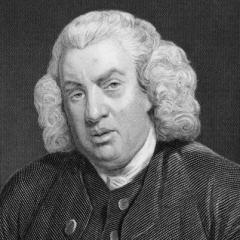
Samuel Johnson
Samuel Johnson

Samuel Johnson was an English writer, poet, and lexicographer, renowned for his comprehensive English dictionary, 'A Dictionary of the English Language', published in 1755. His distinctive writing style and wit have cemented his place as a significant figure in the history of English literature. more

You May Also Like

“The power, indeed, of every individual is small, and the consequence of his endeavours imperceptible, in a general prospect of the world. Providence has given no man ability to do much, that something might be left for every man to do. The business of life is carried on by a general co-operation; in which the part of any single man can be no more distinguished, than the effect of a particular drop when the meadows are floated by a summer shower: yet every drop increases the inundation, and every hand adds to the happiness or misery of mankind.”

“He that compares what he has done with what he has left undone, will feel the effect which must always follow the comparison of imagination with reality; he will look with contempt on his own unimportance, and wonder to what purpose he came into the world; he will repine that he shall leave behind him no evidence of his having been, that he has added nothing to the system of life, but has glided from youth to age among the crowd, without any effort for distinction.”

“He that would travel for the entertainment of others, should remember that the great object of remark is human life. Every Nation has something peculiar in its Manufactures, its Works of Genius, its Medicines, its Agriculture, its Customs, and its Policy. He only is a useful Traveller, who brings home something by which his country may be benefited; who procures some supply of Want, or some mitigation of Evil, which may enable his readers to compare their condition with that of others, to improve it whenever it is worse, and whenever it is better to enjoy it.”

“It is commonly supposed that the uniformity of a studious life affords no matter for narration: but the truth is, that of the most studious life a great part passes without study. An author partakes of the common condition of humanity; he is born and married like another man; he has hopes and fears, expectations and disappointments, griefs and joys, and friends and enemies, like a courtier or a statesman; nor can I conceive why his affairs shuld not excite curiosity as much as the whisper of a drawing-room, or the factions of a camp.”