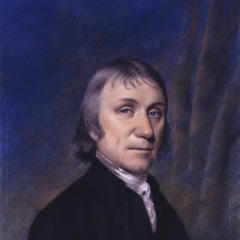
“It is known to all persons who are conversant in experimental philosophy, that there are many little attentions and precautions necessary to be observed in the conducting of experiments, which cannot well be described in words, but which it is needless to describe, since practice will necessarily suggest them; though, like all other arts in which the hands and fingers are made use of, it is only much practice that can enable a person to go through complex experiments, of this or any kind, with ease and readiness.”
Quote by Joseph Priestley
“The mind of man can never be wholly barren. Through our whole lives we are subject to successive impressions; for, either new ideas are continually flowing in, or traces of the old ones are marked deeper. If, therefore, you be not acquiring good principles be assured that you are acquiring bad ones; if you be not forming virtuous habits you are, how insensibly soever to yourselves, forming vicious ones.”
Source: Views of Christian truth, piety, and morality: selected from the writings of Dr. Priestley : with a memoir of his life
“When we say there is a GOD, we mean that there is an intelligent designing cause of what we see in the world around us, and a being who was himself uncaused.”
Source: Institutes of Natural and Revealed Religion: To which is Prefixed, an Essay on the Best Method of Communicating Religious Knowledge to the Members of Christian Societies
“We find upon all occasions, the early Christian writers speak of the Father as superior to the Son, and in general they give him the title of God , as distinguished from the Son; and sometimes they expressly call him, exclusively of the Son, the only true God ; a phraseology which does not at all accord with the idea of the perfect equality of all the persons in the Trinity. But it might well be expected, that the advances to the present doctrine of the Trinity should be gradual and slow. It was, indeed, some centuries before it was completely formed.”
Source: A History of the Corruptions of Christianity
“Most of the early Christian writers thought the text "I and my Father are one," was to be understood of an unity or harmony of disposition only. Thus Tertullian observes, that the expression is unum , one thing, not one person; and he explains it to mean unity, likeness, conjunction, and of the love that the Father bore to the Son. Origen says, "let him consider that text, 'all that believed were of one heart and of one soul,' and then he will understand this, 'I and my Father are one".”
“It is sufficiently evident from many circumstances, that the doctrine of the divinity of Christ did not establish itself without much opposition, especially from the unlearned among the Christians, who thought that it savoured of Polytheism , that it was introduced by those who had had a philosophical education, and was by degrees adopted by others, on account of its covering the great offence of the cross , by exalting the personal dignity of our Saviour.”
Source: A History of the Corruptions of Christianity
“It is hardly possible not to suspect the truth of this doctrine of atonement, when we consider that the general maxims to which it may be reduced, are nowhere laid down, or asserted, in the Scriptures, but others quite contrary to them.”
Source: A History of the Corruptions of Christianity
“From the fame opinion of a soul distinct from the body came the practice of praying, first for the dead, and then to them with a long train of other absurd opinions, and superstitious practices.”
Source: An History of the Corruption of Christianity
“Too many christians have been chargeable with... confounding the Logos of Plato with that of John , and making of it a second person in the trinity, than which no two things can be more different.”
Source: An History of the Corruption of Christianity
“Had Mr. Gibbon lived in France, Spain, or Italy, he might with the fame reason have ranked the doctrine of transubstantiation, and the worship of saints and angels among the essentials of Christianity, as the doctrines of the trinity and of the atonement.”
Source: An History of the Corruptions of Christianity
“Let us not... contend about merit , but let us all be intent on forwarding the common enterprize , and equally enjoy any progress we may make towards succeeding in it; and above all, let us acknowledge the guidance of that Great Being, who has put a spirit in man, and whose inspiration giveth him understanding .”
Source: Experiments and Observations on Different Kinds of Air and Other Branches of Natural Philosophy, Connected with the Subject ...: Being the Former Six Volumes Abridged and Methodized, with Many Additions