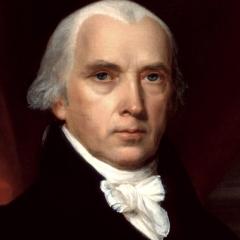
“Is there no virtue among us? If there be not, we are in a wretched situation. No theoretical checks-no form of government can render us secure. To suppose that any form of government will secure liberty or happiness without any virtue in the people, is a chimerical idea, if there be sufficient virtue and intelligence in the community, it will be exercised in the selection of these men. So that we do not depend on their virtue, or put confidence in our rulers, but in the people who are to choose them.”
Quote by James Madison
“If immigration reform passes, it'll be a big victory for sanity - nobody really believes it's healthy for a country to have millions and millions of undocumented noncitizens living in the shadows. But it'll also be a sign that the Republican Party has gotten tired of letting the Tea Party push it around.”
“Can it be, that Providence has not connected the permanent felicity of a Nation with its virtue? The experiment, at least, is recommended by every sentiment which ennobles human Nature. Alas! is it rendered impossible by its vices?”
Source: Washington's Farewell Address: The Proclamation of Jackson Against Nullification, and the Declaration of Independence
“There exists in the economy and course of nature, an indissoluble union between virtue and happiness; between duty and advantage; between the genuine maxims of an honest and magnanimous policy, and the solid rewards of public prosperity and felicity; since we ought to be no less persuaded that the propitious smiles of Heaven can never be expected on a nation that disregards the eternal rules of order and right, which Heaven itself has ordained.”
“The promulgation of the great doctrines of religion, the being, and attributes, and providence of one Almighty God: the responsibility to him for all our actions, founded upon moral freedom and accountability; a future state of rewards and punishments; the cultivation of all the personal, social, and benevolent virtues-these these never can be a matter of indifference in any well-ordered community. It is, indeed, difficult to conceive how any civilized society can exist without them.”
Source: Commentaries on the Constitution of the United States: With a Preliminary Review of the Constitutional History of the Colonies and States, Before the Adoption of the Constitution
“I suppose, indeed, that in public life, a man whose political principles have any decided character and who has energy enough to give them effect must always expect to encounter political hostility from those of adverse principles.”
Source: Memoir, Correspondence, and Miscellanies: From the Papers of Thomas Jefferson
“I cannot however help repeating Piety, because I think it indispensible. Religion in a Family is at once its brightest Ornament & its best Security.”
Source: The Writings of Samuel Adams: 1778-1802
“My confidence is that there will for a long time be virtue and good sense enough in our countrymen to correct abuses.”
Source: Memoir, correspondence, and miscellanies from the papers of T. Jefferson
“The truth is that the general genius of a government is all that can be substantially relied upon for permanent effects. Particular provisions, though not altogether useless, have far less virtue and efficacy than are commonly ascribed to them; and the want of them will never be with men of sound discernment a decisive objection to any plan which exhibits the leading characters of a good government.”
Source: The Works of Alexander Hamilton: Comprising His Most Important Official Reports: An Improved Edition of the Federalist, on the New Constitution, Written in 1788; and Pacificus, on the Proclamation of Neutrality, Written in 1793 ...
“This policy of supplying by opposite and rival interests, the defect of better motives, might be traced through the whole system of human affairs, both private and public.”
Source: The Federalist, on the New Constitution, Written in 1788
“Reason, on the contrary, assures us, that as in so great a number, a fit representative would be most likely to be found, so the choice would be less likely to be diverted from him, by the intrigues of the ambitious, or the bribes of the rich.”
Source: The Federalist Papers: A Collection of Essays Written in Favour of the New Constitution