Quotessence
Home / Quotes / Quote by Joseph Beuys

Quote by Joseph Beuys

“The only hope I had was when (in his youth)I saw one day a photograph of a sculpture by Wilhelm Lehmbruck, a German sculptor of expressionistic style. This was perhaps the only example, Lehmbruck, between my sixteenth to nineteenth years in which I saw a possibility for art to be principally of interest to innovate some things, instead of writing a very boring, naturalistic repetition of what is already done by nature.”

Quote by Joseph Beuys

Author
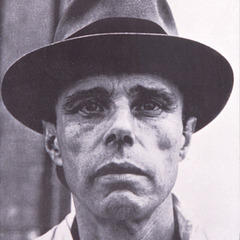
Joseph Beuys
Joseph Beuys

Joseph Beuys was a German artist known for his social-political art and action art. His work often addressed environmental, social, and political issues, and had a profound impact on contemporary art with his unique artistic practice and ideas. more

You May Also Like

“Gender is not something that one is, it is something one does, an act... a "doing" rather than a "being". There is no gender identity behind the expressions of gender; that identity is performatively constituted by the very "expressions" that are said to be its results. If the immutable character of sex is contested, perhaps this construct called 'sex' is as culturally constructed as gender; indeed, perhaps it was always already gender, with the consequence that the distinction between sex and gender turns out to be no distinction at all.”

“Christianity exhorted man to set himself up against Nature, but did so in the name of his spiritual and disinterested attributes. Pragmatism exhorts him to do so in the name of his practical attributes. Formerly man was divine because he had been able to acquire the concept of justice, the idea of law, the sense of God; today he is divine because he has been able to create equipment which makes him the master of matter.”

“Since the Greeks the predominant attitude of thinkers towards intellectual activity was to glorify it insofar as (like aesthetic activity) it finds its satisfaction in itself, apart from any attention to the advantages it may procure. Most thinkers would have agreed with Renan's verdict that the man who loves science for its fruits commits the worst of blasphemies against that divinity. The modern clercs have violently torn up this charter. They proclaim the intellectual functions are only respectable to the extent that they are bound up with the pursuit of concrete advantage.”

“The true clerc is Vauvenargues, Lamarck, Fresnel, Spinoza, Schiller, Baudelaire, César Franck, who were never diverted from single-hearted adoration of the beautiful and the divine by the necessity of earning their daily bread. But such clercs are inevitably rare. The rule is that the living creature condemned to struggle for life turns to practical passions, and thence to the sanctifying of those passions.”