“Such is the uncertainty of human affairs, that security and despair are equal follies; and as it is presumption and arrogance to anticipate triumphs, it is weakness and cowardice to prog-nosticate miscarriages.”
Book:The Rambler
“Such is the uncertainty of human affairs, that security and despair are equal follies; and as it is presumption and arrogance to anticipate triumphs, it is weakness and cowardice to prog-nosticate miscarriages.”
The Rambler is a collection of periodical essays written by Samuel Johnson, published twice weekly between 1750 and 1752. The essays cover a wide range of topics, including ethics, philosophy, literary criticism, and observations on daily life, often presented through fictional characters and allegorical narratives. Johnson's prose is characterized by its moral seriousness, rhetorical elegance, and deep psychological insight, aiming to instruct and improve readers while addressing universal human concerns such as ambition, vanity, and the pursuit of happiness. The work is considered a landmark in English essay writing and a key example of 18th-century moral literature. more
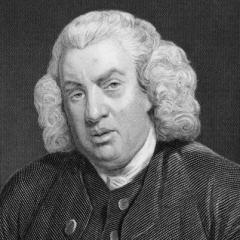
Samuel Johnson was an English writer, poet, and lexicographer, renowned for his comprehensive English dictionary, 'A Dictionary of the English Language', published in 1755. His distinctive writing style and wit have cemented his place as a significant figure in the history of English literature. more
“Beauty, without kindness, dies unenjoyed and undelighting.”
“There is no book so poor that it would not be a prodigy if wholly made by a single man.”
“Care that is once enter'd into the breast Will have the whole possession ere it rest.”
“The peculiar doctrine of Christianity is that of a universal sacrifice and perpetual propitiation.”
“Sir, there is no end of negative criticism.”