Quotessence
Home / Quotes / Quote by Winona LaDuke

Quote by Winona LaDuke

“The military is the largest polluter in the country, and so you have a lot of military waste contaminating reservations - as, for example, on the Skull Valley Goshute Reservation, where 5,000 sheep died in some kind of experimental military nerve gas test 10 years ago. Many of our communities are dealing with that kind of waste, and an absence of political will to clean them up.”

Quote by Winona LaDuke

Author
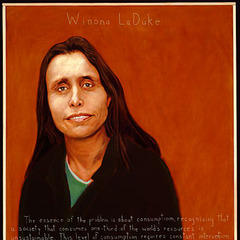
Winona LaDuke
Winona LaDuke

Winona LaDuke is an American activist and a prominent figure in the environmental and Native American rights movements. Born on August 18, 1959, she has dedicated her life to advocating for indigenous peoples and sustainable living, working on issues such as environmental degradation and the protection of indigenous lands. more

You May Also Like

“Uranium mining in northern Canada has left over 120 million tons of radioactive waste. This amount represents enough material to cover the Trans-Canada Highway two meters deep across the country. Present production of uranium waste from Saskatchewan alone occurs at the rate of over 1 million tons annually. Since 1975, hospitalization for cancer, birth defects and circulatory illnesses in that area have increased dramatically - between 123 and 600 percent in that region.”

“Very few people would choose to have even the most fabled assortment of goods if it meant getting cancer within the year. But the choice involves not the certainty of cancer very soon but an increased probability of cancer at some time in the future. The cancers are no less real; millions will die painfully and prematurely because of what we do to our environment. But the choice is not an easily visualizable one, and our capacity of denial comes strongly into play - as it tends to whenever we must weigh future costs against immediate benefits.”

“We are committed to cleaning up the air and cleaning up the water. But we also are committed to a strong economy, and we are not going to allow the environmental issue to be used sometimes falsely and sometimes in a demagogic way basically to destroy the system-the industrial system that made this the great country it is.”

“We can break the mountains apart; we can drain the rivers and flood the valleys. We can turn the most luxuriant forests into throw-away paper products. We can tear apart the great grass cover of the western plains and pour toxic chemicals into the soil and pesticides onto the fields until the soil is dead and blows away in the wind. We can pollute the air with acids, the rivers with sewage, the seas with oil - all this in a kind of intoxication with our power for devastation at an order of magnitude beyond all reckoning.”

“We can decide that the presence of cancer-causing substances in our air, water, and food is too expensive. A 2009 study, for example, has found that coal miners in Appalachia costs the region five times more in premature deaths, including from cancer, than it provides to the region in jobs, taxes, and economic benefits. In California, the production and use of hazardous chemicals cost the state $2.6 billion in 2004 alone in lost wages and health-care expenses to treat workers and children with pollution-linked diseases.”

“We must recognize that the goal of a cleaner environment will not be achieved by rhetoric or moral dedication alone. It will not be cheap or easy and the costs will have to be borne by each citizen, consumer and taxpayer. How clean is clean enough can only be answered in terms of how much we are willing to pay and how soon we seek success... It is simplistic to seek ecological perfection at the cost of bankrupting the very tax-paying enterprises which must pay for the social advances we seek.”

“What can be done? Well, the governments of the world can undertake what amounts to a vast clean-up campaign and a vast campaign of organic renewal. The problem is the cost of an effective operation, which is enormous, and thus must be paid by someone via some form of taxes.”

“What, then, is the effect of pesticides? Pesticides have created a legacy of pain, and misery, and death for farm workers and consumers alike. The crop which poses the greatest danger, and the focus of our struggle, is the table grape crop. These pesticides soak the fields. Drift with the wind, pollute the water, and are eaten by unwitting consumers. These poisons are designed to kill, and pose a very real threat to consumers and farm workers alike.”

“When it comes to acid rain or oil spills or depleted fisheries or tainted groundwater or fluorocarbon propellants or radiation leaks or sexually transmitted diseases, national frontiers are simple irrelevant. Toxins don't stop for customs inspections and microbes don't carry passports. North America became a water and free-trade zone long before NAFTA loosened up the market in goods.”