“An age that melts in unperceiv'd decay, And glides in modest innocence away.”
Quote by Samuel Johnson
Work
The poetical works of Samuel Johnson: collated with the best editions
This volume presents the complete poetical writings of Samuel Johnson, the eighteenth-century English writer, critic, and lexicographer. The edition has been prepared through collation with established authoritative editions, indicating an editorial effort to establish accurate texts. Johnson's poetry, though less celebrated than his prose works such as his Dictionary of the English Language or his Lives of the Poets, includes compositions in various forms including Latin verse, English lyrics, and the tragedy Irene. The collection reflects the neoclassical style prevalent during Johnson's lifetime, characterized by formal structures, moral themes, and learned allusions. The editorial approach of collating with best editions suggests attention to textual accuracy and bibliographic scholarship, typical of nineteenth-century publishing practices for canonical authors. more
Author
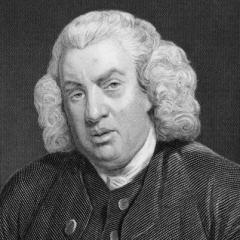
Samuel Johnson
Samuel Johnson was an English writer, poet, and lexicographer, renowned for his comprehensive English dictionary, 'A Dictionary of the English Language', published in 1755. His distinctive writing style and wit have cemented his place as a significant figure in the history of English literature. more
You May Also Like
“Her modest looks the cottage might adorn, Sweet as the primrose peeps beneath the thorn.”
Source: Goldsmith's Deserted village, with notes and a life of the poet by W. M'Leod. (Oxf. exam. scheme).
Source: The Poetical Works of John Milton: With Notes of Various Authors; and with Some Account of the Life and Writings of Milton, Derived Principally from Original Documents in Her Majesty's State-paper Office
Source: Becoming light: poems, new and selected
“Honor modesty more than your life.”
Source: Aeschylus: The suppliant maidens, The Persians, translated by S. G. Benardete. Seven against Thebes, Prometheus bound, translated by D. Grene
“The girl who chooses to be modest, chooses to be respected.”