Quotessence
Home / Quotes / Quote by Karl Marx

Quote by Karl Marx

“To sum up: the more productive capital grows, the more it extends the division of labour and the application of machinery; the more the division of labour and the application of machinery extend, the more does competition extend among the workers, the more do their wages shrink together.”

Quote by Karl Marx

Work

Wage-Labour and Capital & Value, Price and Profit

Browse quotes and source details for this work. more

Author
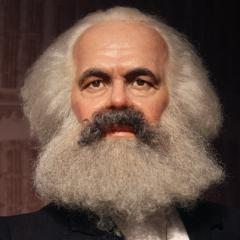
Karl Marx
Karl Marx

Karl Marx (May 5, 1818 - March 14, 1883) was a German philosopher, economist, sociologist, political theorist, and revolutionary. He is one of the founders of Marxism and his works, including 'Das Kapital' and 'The Communist Manifesto', have had a profound impact on the world. more

You May Also Like

“The sum of productive forces, capital funds and social forms of intercourse, which every individual and generation finds in existence as something given, is the real basis of what the philosophers have conceived as "substance" and "essence of man," and what they have deified and attacked: a real basis which is not in the least disturbed, in its effect and influence on the development of men, by the fact that these philosophers revolt against it as "self-consciousness" and the "Unique.”

“We have seen in detail above that the ultimate earnings of factors go to the owners of labor and of ground land and, as interest, to capitalists. If land can be capitalized, does this not mean that land and capital goods are “really the same thing” after all? The answer to the latter question is No.25It is still emphatically true that the earnings of basic land factors are ultimate and irreducible, as are labor earnings, while capital goods have to be constantly produced and reproduced, and therefore their earnings are always reducible to the earnings of ground land, labor, and time.”

“If capital is what produces a stream of income - and that is a definition no one seems to quarrel with - then it follows that software is a form of capital. It has always been difficult to measure any form of knowledge capital, but in the past the problem was not as urgent, since the ratio of difficult-to-quantify knowledge capital to more tangible capital was not as high or growing as rapidly as it is today.”

“Pakistanis often recount how civil servants in Pakistan’s early days worked out of makeshift offices, lived in tents and ran the government with limited stationery supplies. While the account is generally accurate, and the sacrifice of the officials admirable, it is equally important to understand that the difficulty was the result of a poor choice. Pakistan’s founder had selected the country’s capital to be located in a city lacking adequate facilities, preferring it over another provincial capital with a better establishment.”

“Man's nature, he postulated, was to be a "free conscious producer," but so far he had not been able to express himself freely in productive activity. He had been driven to produce by need and greed, by a passion for accumulation which in the modern bourgeois age becomes accumulation of capital. His productive activity had always, therefore, been involuntary; it had been "labour.”

“It is noteworthy that the Muslim League had campaigned for Pakistan for seven years without deciding what its capital might be. The Bengalis proposed Dhaka while others suggested Lahore and even Multan, a historic city in the south of Punjab. But the subject was never seriously discussed while rallying Muslims to the cause of Pakistan. After belatedly deciding on Karachi as the capital, Muslim League leaders expected the British Indian Army to resolve the problems they might encounter in accommodating the government of their new country. This was one of the earliest manifestations of Pakistan’s tendency to rely on the military as the solution to problems normally falling in the civilian domain.”