Quotessence
Home / Quotes / Quote by Winona LaDuke

Quote by Winona LaDuke

“Brothers and Sisters: Our ancient homeland is spotted today with an array of chemical dumps. Along the Niagara River, dioxin, a particularly deadly substance, threatens the remaining life there and in the waters which flow from there. Forestry departments spray the surviving forests with powerful insecticides to encourage tourism by people seeking a few days or weeks away from the cities where the air hangs heavy with sulphur and carbon oxides.”

Quote by Winona LaDuke

Author
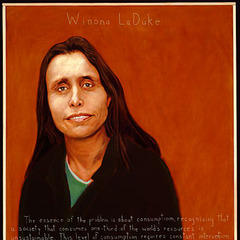
Winona LaDuke
Winona LaDuke

Winona LaDuke is an American activist and a prominent figure in the environmental and Native American rights movements. Born on August 18, 1959, she has dedicated her life to advocating for indigenous peoples and sustainable living, working on issues such as environmental degradation and the protection of indigenous lands. more

You May Also Like

“The insecticides kill the black flies, but also destroy much of the food chain for the bird, fish, and animal life which also inhabit those regions. The fish of the Great Lakes are laced with mercury from industrial plants, and fluoride from aluminum plants poisons the land and the people. Sewage from the population centers is mixed with PCBs and PBS in the watershed of the great lakes and the Finger Lakes, and the water is virtually nowhere safe for any living creatures.”

“Indeed, the quantity of PCBs still in use plus the quantity still languishing in waste dumps exceeds the total amount that has already escaped into the general environment. Without a program to recall and contain them, semivolatile PCBs will continue to insinuate themselves into the food chain for decades.”

“By 1990, the EPA had tallied up 32,645 sites of past chemical waste dumping in need of cleanup. Some of these are actual waste landfills, but many are former manufacturing sites where drums full of chemicals have been simply abandoned. The names of the most notorious appear on the EPS's National Priorities List. These are the so-called Superfund sites, names for the super fund of money put together by Congress in 1980 to clean them up. In 2009, the Superfund list contained 1,331 sites.”

“God then makes people whom he puts right in the middle of all this loaded creation. Commanding them to care for creation, to manage it, to lovingly use it, to creatively order it... They are environmentalists. Being deeply connected with their environment is who they are. For them to be anything else or to deny their divine responsibility to care for all that God has made would be to deny something that is at the core of their existence. This is why litter and pollution are spiritual issues.”

“How would you describe the difference between modern war and modern industry-between say, bombing and strip mining, or between chemical warfare and chemical manufacturing? The difference seems to be only that in war the victimization of humans is directly intentional and in industry it is "accepted" as a "trade-off." Were the catastrophes of Love Canal, Bhopal, Chernobyl, and the Exxon Valdez episodes of war or of peace? They were in fact, peacetime acts of aggression, intentional to the extent that the risks were known and ignored.”

“I find man utterly unaware of what his wealth is or his fundamental capability is. He says time and again, "We can't afford it." For instance, we are saying now that we can't afford to do anything about pollution but after the costs of not doing something about pollution have multiplied many fold beyond what it would cost to correct it now, we will spend many fold what it would cost us now to correct it.”

“Here in the United States, a study of nearly 700 women in California showed an increased risk of fetal death among babies whose mothers lived near crops when certain pesticides were sprayed. The largest risks were found among pregnant women exposed during the critical first trimester and among those who lived in the same square mile where pesticides were used.”

“Industrialized countries have disproportionately more cancers than countries with little or no industry (after adjusting for age and population size). One half of all the world's cancers occur in people living in industrialized countries, even though we are only one-fifth of the world's population. Closely tracking industrialization are breast cancer rates, which are highest in North America and northern Europe, intermediate in southern Europe and Latin America, and lowest in Asia and Africa.”

“Man was the outlaw, the rebel, the distorted shape that scarred the earth, the voice that silenced the music of Eden, the hand that raised up obscenities and blasphemies. Man was the pariah-dog, the moral leper in this translucent mirror of Heaven. He was the muddier of crystal waters, the despoiler of forests, the murderer of the innocent, the challenger against God. He was the assassin of the saints and the prophets, for they spoke of what he WOULD NOT HEAR, in the darkness of his spirit!”