Quotessence
Home / Quotes / Quote by Kofi Annan

Quote by Kofi Annan

“Tolerance, inter-cultural dialogue and respect for diversity are more essential than ever in a world where peoples are becoming more and more closely interconnected.”

Quote by Kofi Annan

Author
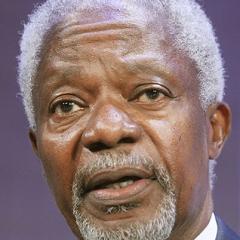
Kofi Annan
Kofi Annan

Kofi Annan, born on April 8, 1938, is an accomplished diplomat. He served in various significant roles at the United Nations, culminating in his tenure as the seventh Secretary-General. Known for his contributions to peace and security, Annan was awarded the Nobel Peace Prize. more

You May Also Like

“People of different religions and cultures live side by side in almost every part of the world, and most of us have overlapping identities which unite us with very different groups. We can love what we are, without hating what – and who – we are not. We can thrive in our own tradition, even as we learn from others, and come to respect their teachings.”

“What then is the source of my errors? They are owing simply to the fact that, since the will extends further than the intellect, I do not contain the will within the same boundaries; rather, I also extend it to things I do not understand. Because the will is indifferent in regard to such matters, it easily turns away from the true and the good; and in this way I am deceived and I sin.”

“To see ten thousand animals untamed and not branded with the symbols of human commerce is like scaling an unconquered mountain for the first time, or like finding a forest without roads or footpaths, or the blemish of an axe. You know then what you had always been told -- that the world once lived and grew without adding machines and newsprint and brick-walled streets and the tyranny of clocks.”

“To an eagle or to an owl or to a rabbit, man must seem a masterful and yet a forlorn animal; he has but two friends. In his almost universal unpopularity he points out, with pride, that these two are the dog and the horse. He believes, with an innocence peculiar to himself, that they are equally proud of this alleged confraternity. He says, 'Look at my two noble friends -- they are dumb, but they are loyal.' I have for years suspected that they are only tolerant.”

“What a child does not know and does not want to know of race and colour and class, he learns soon enough as he grows to see each man flipped inexorably into some predestined groove like a penny or a sovereign in a banker's rack. Kibii, the Nandi boy, was my good friend. Arab Ruta (the same boy grown to manhood), wo sits before me, is my good friend, but the handclasp will be shorter, the smile will not be so eager on his lips, and though the path is for a while the same, he will walk behind me now, when once, in the simplicity of our nonage, we walked together.”