“God put a secret art into the forces of Nature so as to enable it to fashion itself out of chaos into a perfect world system.”
Quote by Immanuel Kant
Work
Kant's cosmogony as in his essay on the retardation of the rotation of the earth and his Natural history and theory of the heavens: With introduction, appendices, and a portrait of Thomas Wright of Durham
The book delves into Immanuel Kant's philosophical and scientific ideas regarding the cosmos, focusing on his essay discussing the slowing of the Earth's rotation and his comprehensive treatise on natural history and celestial mechanics. It features an introduction that sets the context for Kant's work, appendices that provide additional information, and a portrait of Thomas Wright of Durham, a contemporary astronomer. The book is a scholarly examination of Kant's contributions to the understanding of the universe and the development of scientific thought. more
Author
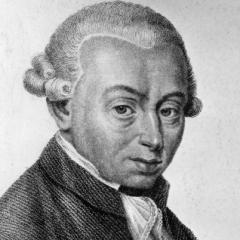
Immanuel Kant
German philosopher, an important representative of the Enlightenment movement, and the founder of the Kantian philosophical system. His thoughts have had a profound impact on the fields of philosophy, ethics, political science, and others. more
You May Also Like
“In nature things move violently to their place, and calmly in their place.”
Source: The works of Francis Bacon, Baron of Verulam, Viscount St. Alban, and Lord High Chancellor of England, in five volumes
Source: Preliminary discourse on the study of natural philosophy
Source: Theoretical Philosophy, 1755-1770