Quotessence
Home / Quotes / Quote by Sigmund Freud

Quote by Sigmund Freud

Work

The standard edition of the complete psychological works of Sigmund Freud

This book is a seminal work in the field of psychology, compiling the extensive writings of Sigmund Freud, a pioneer in the development of psychoanalysis. It includes his seminal theories on the unconscious mind, dreams, and the structure of the psyche. more

Author
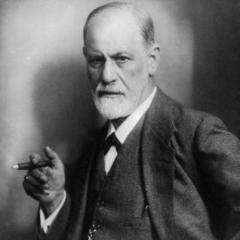
Sigmund Freud
Sigmund Freud

Sigmund Freud, born on May 6, 1856, in Moravia, and died on September 23, 1939, in London, was an Austrian neurologist and the founder of psychoanalysis. Known as the father of modern psychology, Freud made significant contributions to the understanding of human psychology, introducing concepts such as the unconscious mind, dream analysis, and sexual theory. more

You May Also Like

“When it happens that a person has to give up a sexual object, there quite often ensues an alteration of his ego which can only be described as a setting up of the object inside the ego, as it occurs in melancholia; the exact nature of this substitution is as yet unknown to us.”

“In the theory of psycho-analysis we have no hesitation in assuming that the course taken by mental events is automatically regulated by the pleasure principle. We believe, that is to say, that the course of those events is invariably set in motion by an unpleasurable tension, and that it takes a direction such that its final outcome coincides with a lowering of that tension that is, with an avoidance of unpleasure or a production of pleasure.”

“It must be pointed out, however, that strictly speaking it is incorrect to talk of the dominance of the pleasure principle over the course of mental processes. If such a dominance existed, the immense majority of our mental processes would have to be accompanied by pleasure or to lead to pleasure, whereas universal experience completely contradicts any such conclusion.”

“The pleasure principle long persists, however, as the method of working employed by the sexual instincts, which are so hard to 'educate', and, starting from those instincts, or in the ego itself, it often succeeds in overcoming the reality principle, to the detriment of the organism as a whole.”

“The study of dreams may be considered the most trustworthy method of investigating deep mental processes. Now dreams occurring in traumatic neuroses have the characteristic of repeatedly bringing the patient back into the situation of his accident, a situation from which he wakes up in another fright.”

“At first the analysing physician could do no more than discover the unconscious material that was concealed from the patient, put it together, and, at the right moment, communicate it to him. Psychoanalysis was then first and foremost an art of interpreting. Since this did not solve the therapeutic problem, a further aim quickly came in view: to oblige the patient to confirm the analyst's construction from his own memory.”

“The unconscious - that is to say, the 'repressed' - offers no resistance whatever to the efforts of the treatment. Indeed, it itself has no other endeavour than to break through the pressure weighing down on it and force its way either to consciousness or to a discharge through some real action.”