Quotessence
Home / Quotes / Quote by Sigmund Freud

Quote by Sigmund Freud

“The facts which have caused us to believe in the dominance of the pleasure principle in mental life also find expression in the hypothesis that the mental apparatus endeavours to keep the quantity of excitation present in it as low as possible or at least to keep it constant.”

Quote by Sigmund Freud

Work

Beyond the Pleasure Principle

Sigmund Freud's seminal work delves into the nature of human instinct and the pleasure principle, offering insights into the unconscious mind and its influence on human behavior. more

Author
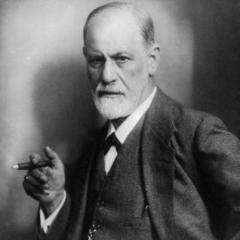
Sigmund Freud
Sigmund Freud

Sigmund Freud, born on May 6, 1856, in Moravia, and died on September 23, 1939, in London, was an Austrian neurologist and the founder of psychoanalysis. Known as the father of modern psychology, Freud made significant contributions to the understanding of human psychology, introducing concepts such as the unconscious mind, dream analysis, and sexual theory. more

You May Also Like

“It must be pointed out, however, that strictly speaking it is incorrect to talk of the dominance of the pleasure principle over the course of mental processes. If such a dominance existed, the immense majority of our mental processes would have to be accompanied by pleasure or to lead to pleasure, whereas universal experience completely contradicts any such conclusion.”

“The pleasure principle long persists, however, as the method of working employed by the sexual instincts, which are so hard to 'educate', and, starting from those instincts, or in the ego itself, it often succeeds in overcoming the reality principle, to the detriment of the organism as a whole.”

“The study of dreams may be considered the most trustworthy method of investigating deep mental processes. Now dreams occurring in traumatic neuroses have the characteristic of repeatedly bringing the patient back into the situation of his accident, a situation from which he wakes up in another fright.”

“At first the analysing physician could do no more than discover the unconscious material that was concealed from the patient, put it together, and, at the right moment, communicate it to him. Psychoanalysis was then first and foremost an art of interpreting. Since this did not solve the therapeutic problem, a further aim quickly came in view: to oblige the patient to confirm the analyst's construction from his own memory.”

“The unconscious - that is to say, the 'repressed' - offers no resistance whatever to the efforts of the treatment. Indeed, it itself has no other endeavour than to break through the pressure weighing down on it and force its way either to consciousness or to a discharge through some real action.”

“What psycho-analysis reveals in the transference phenomena of neurotics can also be observed in the lives of some normal people. The impression they give is of being pursued by a malignant fate or possessed by some 'daemonic' power; but psycho-analysis has always taken the view that their fate is for the most part arranged by themselves and determined by early infantile influences.”

“What is a totem? It is as a rule an animal (whether edible and harmless or dangerous and feared) and more rarely a plant or a natural phenomenon (such as rain or water), which stands in a peculiar relation to the whole clan. In the first place, the totem is the common ancestor of the clan; at the same time it is their guardian spirit and helper, which sends them oracles and, if dangerous to others, recognizes and spares its own children.”