“There are some works which the authors must consign unpublished to posterity, however uncertain be the event, however hopeless be the trust. He that writes the history of his own times, if he adhere steadily to truth, will write that which his own times will not easily endure. He must be content to reposite his book till all private passions shall cease, and love and hatred give way to curiosity.”
Quote by Samuel Johnson
Work
The Works of Alexander Pope, Esq. in Verse and Prose: Containing the Principal Notes of Drs. Warburton and Warton: Illustrations, and Critical and Explanatory Remarks, by Johnson, Wakefield, A. Chalmers ... and Others; to which are Added, Now First Published, Some Original Letters, with Additional Observations, and Memoirs of the Life of the Author
This book is a compilation of Alexander Pope's literary works, spanning both verse and prose. It includes critical annotations by Drs. Warburton and Warton, as well as additional observations and commentary. The volume also features a selection of Pope's original letters, published for the first time, along with biographical notes and a memoir of the author's life. more
Author
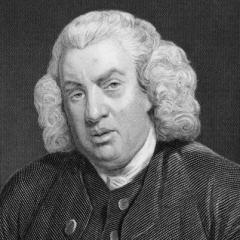
Samuel Johnson
Samuel Johnson was an English writer, poet, and lexicographer, renowned for his comprehensive English dictionary, 'A Dictionary of the English Language', published in 1755. His distinctive writing style and wit have cemented his place as a significant figure in the history of English literature. more
You May Also Like
Source: The Works of Samuel Johnson, LL.D.: With An Essay on His Life and Genius
Source: The Rambler: A Periodical Paper, Published in 1750, 1751, 1752
Source: The Works of Samuel Johnson, L. L. D.: In Twelve Volumes
“While there I began to study the Asian religions as theories of mind.”
Source: The Rambler: A Periodical Paper, Published in 1750, 1751, 1752
Source: The Rambler: A Periodical Paper, Published in 1750, 1751, 1752
Source: The critical opinions of Samuel Johnson
Source: The Works of Samuel Johnson, LL.D.: With An Essay on His Life and Genius
“I told them not to worry about it, since we were going to play indoors.”