Quotessence
Home / Quotes / Quote by Reinhold Niebuhr

Quote by Reinhold Niebuhr

Work

Moral Man and Immoral Society: A Study in Ethics and Politics

This book delves into the complex relationship between personal morality and the moral fabric of society, exploring the reasons behind the disconnect between ethical behavior on an individual level and the ethical standards of a collective group. more

Author
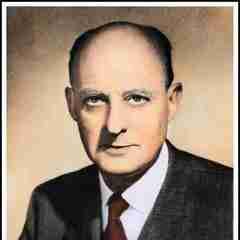
Reinhold Niebuhr
Reinhold Niebuhr

Reinhold Niebuhr was a prominent American theologian whose work on Christian ethics and social ethics had a profound impact on the 20th century. He was a key figure in theological discourse, particularly for his exploration of the nature of sin and the church's role in society. Niebuhr's theological thought has influenced various Christian denominations and has had a lasting effect on political and social thought. more

You May Also Like

“... the modern state masks itself in moral ideologies which obscure its actual conduct. One of the most compelling and insidious of these ideologies is the doctrine of natural rights. It was to secure these rights that the modern state was invented in the first place, and it is impossible, especially for Americans, not to be seduced by the doctrine. But it is nonetheless a philosophical superstition.”

“... an essential feature of a decent society, and an almost defining feature of a democratic society, is relative equality of outcome - not opportunity, but outcome. Without that you can't seriously talk about a democratic state... These concepts of the common good have a long life. They lie right at the core of classical liberalism, of Enlightenment thinking... Like Aristotle, [Adam] Smith understood that the common good will require substantial intervention to assure lasting prosperity of the poor by distribution of public revenues.”

“Our popular economics writers, however, are not in the business of giving their readers a ringside seat on the research action; with no exception I can think of, they use their books to do an end run around the normal structure of scholarship, to preach ideas that few serious economists share. Often, these ideas are not just at odds with the professional consensus; they are demonstrably wrong, and sometimes terminally silly. But they sound good to the unwary reader.”

“A favorite Wired icon for the information feedback loop, a dragon curling in a circle to swallow its own tail, could become more apt as a symbol of the timeless libertarian paradox: Monopoly verging on feudalism emerges from unregulated competition to bite libertarianism in the posterior.”