Quotessence
Home / Quotes / Quote by Samuel Johnson

Quote by Samuel Johnson

Work

The Wisdom of the Rambler, Adventurer, and Idler

This book delves into the profound insights gained from the experiences of rambling, adventuring, and idling, offering a unique perspective on the value of these activities in personal growth and understanding of the world. more

Author
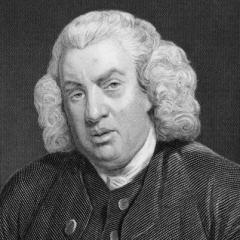
Samuel Johnson
Samuel Johnson

Samuel Johnson was an English writer, poet, and lexicographer, renowned for his comprehensive English dictionary, 'A Dictionary of the English Language', published in 1755. His distinctive writing style and wit have cemented his place as a significant figure in the history of English literature. more

You May Also Like

“There are certain topicks which are never exhausted. Of some images and sentiments the mind of man may be said to be enamoured; it meets them, however often they occur, with the same ardour which a lover feels at the sight of his mistress, and parts from them with the same regret when they can no longer be enjoyed.”

“When a poet mentions the spring, we know that the zephyrs are about to whisper, that the groves are to recover their verdure, the linnets to warble forth their notes of love, and the flocks and herds to frisk over vales painted with flowers: yet, who is there so insensible of the beauties of nature, so little delighted with the renovation of the world, as not to feel his heart bound at the mention of the spring?”

“General irregularities are known in time to remedy themselves. By the constitution of ancient Egypt, the priesthood was continually increasing, till at length there was no people beside themselves; the establishment was then dissolved, and the number of priests was reduced and limited. Thus among us, writers will, perhaps, be multiplied, till no readers will be found, and then the ambition of writing must necessarily cease.”

“To write is, indeed, no unpleasing employment, when one sentiment readily produces another, and both ideas and expressions present themselves at the first summons; but such happiness, the greatest genius does not always obtain; and common writers know it only to such a degree, as to credit its possibility. Composition is, for the most part, an effort of slow diligence and steady perseverance, to which the mind is dragged by necessity or resolution, and from which the attention is every moment starting to more delightful amusements.”

“Every man speaks and writes with intent to be understood; and it can seldom happen but he that understands himself, might convey his notions to another, if, content to be understood, he did not seek to be admired; but when once he begins to contrive how his sentiments may be received, not with most ease to his reader, but with most advantage to himself, he then transfers his consideration from words to sounds, from sentences to periods, and, as he grows more elegant, becomes less intelligible.”

“There are some works which the authors must consign unpublished to posterity, however uncertain be the event, however hopeless be the trust. He that writes the history of his own times, if he adhere steadily to truth, will write that which his own times will not easily endure. He must be content to reposite his book till all private passions shall cease, and love and hatred give way to curiosity.”

“Many leave the labours of half their life to their executors and to chance, because they will not send them abroad unfinished, and are unable to finish them, having prescribed to themselves such a degree of exactness as human diligence can scarcely ontain.”