Quotessence
Home / Quotes / Quote by Wilford Woodruff

Quote by Wilford Woodruff

“When mourning the loss of our departed friends, I cannot help but think that in every death there is a birth; the spirit leaves the body dead to us, and passes to the other side of the veil alive to that great and noble company that are also working for the accomplishment of the purpose of God, in the redemption and salvation of a fallen world.”

Quote by Wilford Woodruff

Work

The Discourses of Wilford Woodruff

This book compiles a selection of Wilford Woodruff's discourses, offering insights into his teachings and perspectives on various religious and social issues relevant to the Latter-day Saint community. more

Author
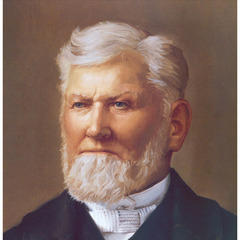
Wilford Woodruff
Wilford Woodruff

Wilford Woodruff (March 1, 1807 – September 2, 1898) was the fourth president of The Church of Jesus Christ of Latter-day Saints, serving from 1890 until his death. He is best known for issuing the 1890 Manifesto, which ended the practice of plural marriage within the church. Under his leadership, the church navigated through a critical period of external pressure and internal adjustment, setting the foundation for its modern development. more

You May Also Like

“I have faith that if we caught hold of God's living candle on that truth and went out into the world-I don't care [what vocation] -just out in the world being true to the vision, we would not need to defend the cause of Jesus Christ. People would come and ask; "Where have you found the radiance that I sense in your eyes and in your face? How come you don't get carried away with the world?" And we would answer that the work of salvation is the glorious work of Jesus Christ. But it is also the glorious work of the uncovering and recovering of your own latent divinity.”

“In questions of this sort there are two things to be observed. First, that the truth of the Scriptures be inviolably maintained. Secondly, since Scripture doth admit of diverse interpretations, that no one cling to any particular exposition with such pertinacity that, if what he supposed to be the teaching of Scripture should afterward turn out to be clearly false, he should nevertheless still presume to put it forward, lest thereby the sacred Scriptures should be exposed to the derision of unbelievers and the way of salvation should be closed to them.”

“Salvation and justice are not to be found in revolution, but in evolution through concord. Violence has ever achieved only destruction, not construction; the kindling of passions, not their pacification; the accumulation of hate and destruction, not the reconciliation of the contending parties; and it has reduced men and parties to the difficult task of building slowly after sad experience on the ruins of discord.”

“Our God is a God of love. He waits with open arms, and the unfolding of His merciful plan of salvation is not only therefore the mark of divine power but also the mark of God's relentless, redeeming love. It is a point well worth pondering because, among other reasons, it will help us to understand better why God, through the prophets, denounces sin and corruption in such scalding terms. He loves all of us, His spirit sons and daughters, but hates our vices. His denunciation of those vices may, if we are not careful, seem to obscure the enormous and perfect love He has for us.”

“As the innocent infant relies upon the mother for sustenance, so the innocent wanderer, following his native compassion and bliss, relies upon the natural intelligence of life to sustain him. There are various Ways. There is the Way of salvation by the law of Buddha, the Way of Confucius governing the Way of learning, the Way of healing as a doctor, as a poet teaching the Way of Waka, tea, archery, and many arts and skills. Each man practices as he feels inclined.”