Quotessence
Home / Quotes / Quote by Annie Duke

Quote by Annie Duke

“In rock, paper, scissors the key is, and this is the best piece of advice that I can give you, if you do think that you recognize the pattern from your opponent, it's good to try to throw a tie as opposed to a win. A tie will very often get you a tie or a win, whereas a win will get you a win or a loss. For example, if you think that someone might throw a rock, it's good to throw rock back at them. You should be going for ties. That's actually a really good strategy to win at rock, paper, scissors. There's my rock, paper, scissors advice for you.”

Quote by Annie Duke

Author
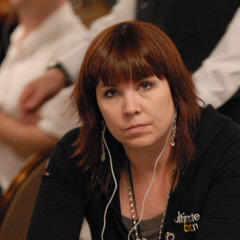
Annie Duke
Annie Duke

Annie Duke, born on September 13, 1965, is a talented American actress with a diverse career spanning film, television, and theater. Known for her unique acting style and versatile character choices, Duke has delivered memorable performances that have left a lasting impression on audiences. more

You May Also Like

“There are four accounts of the gospel itself! The momentous events of the conception, birth, life, teaching, death, resurrection, and ascension of Jesus of Nazareth are too vast to be adequately viewed from one angle alone. Just as we need several points of view to "see" a person's face, so we need these varied emphases and angles to gain the full perspective of all God wants us to understand.”

“As Paul says, even though we as human beings know God, we refuse to acknowledge him. That's what Peter did. He refused even to "know" Jesus! Peter's failure reflects all our failure. It forces us to face the reality about ourselves. But the point of the story is that Jesus foretold this - he knew it was coming. And Jesus forgave Peter, when Peter confessed his love for Jesus. So the story illustrates both the horrible nature of sin, and the amazing reality of grace. That's essential to the whole meaning of the gospel.”

“"It is finished" means that Jesus had accomplished all that God's mission had sent him to do. It did not merely mean that his life was over like, "I'm finished". It was a statement of achievement of purpose - God's purpose to deal with sin and guilt, to defeat all the powers of evil, to bring about the reconciliation of enemies, to defeat death itself, and to accomplish the reconciliation and liberation of the whole creation.”

“I naturally gravitate toward the big picture which isn't necessarily advantageous when you go on to a career in research because successful researchers usually choose a pretty narrow channel. So having tunnel vision actually helps you stay where you are supposed to stay. The big picture in medical care was looking at the underlying causes of all of this pathology. I really wanted to do something about that and play a meaningful role in changing the trajectory of people's lives and their health and by changing their health, changing the quality of their lives.”

“We have literature indicating that overwhelmingly, health is influenced by a very short list of modifiable behaviors topped by three: tobacco use, physical activity and dietary pattern. You could modify those three things; you can change people's fate. I wanted to change those. Smoking cessation, important but relatively simple - a lot of people are working on that. Physical activity: important to me, important to health but also relatively simple. I like nutrition. It's complicated; you really need to learn a lot of stuff to be an expert there.”

“When I went to medical school, I was taught about two basic kinds of diabetes: juvenile onset and adult onset. From the time I did my training in medical school to the end of my residency we were already seeing the transformation of adult onset diabetes into Type II, which is what we call it now, which from my perspective is a euphemism we have draped over this condition to conceal the fact that what was a chronic disease in midlife is now epidemic in children. Frankly, Type II diabetes in a seven year old is adult onset diabetes. We just don't want to confront that unpleasant fact.”

“My view is, in between environmental determinism and personal responsibility, we say, "where there's a will there's a way." It's not true. You really need both and they're somewhat independent. We must both cultivate will and pave the way. If you inspire an impassioned people so that they have the will but there's no way, all around them are walls with no doors or windows. It's terribly frustrating. On the other hand, if you put a very nice way at their feet and they have no will to follow it, that doesn't produce anything very good either. Will is not way. You need both.”