Quotessence
Home / Quotes / Quote by Herman Boerhaave

Quote by Herman Boerhaave

Author

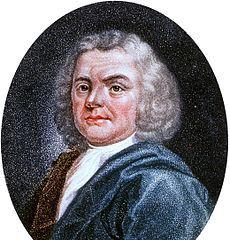
Herman Boerhaave
Herman Boerhaave

Herman Boerhaave was a Dutch botanist and physician, born on December 31, 1668, and died on September 23, 1738. He made significant contributions to both botany and medicine, often referred to as 'the Avicenna of the Netherlands'. more

You May Also Like

“I consider the differences between man and animals in propensities, feelings, and intellectual faculties, to be the result of the same cause as that which we assign for the variations in other functions, viz. difference of organization; and that the superiority of man in rational endowments is not greater than the more exquisite, complicated, and perfectly developed structure of his brain, and particularly of his ample cerebral hemispheres, to which the rest of the animal kingdom offers no parallel, nor even any near approximation, is sufficient to account for.”

“If there is any kind of animal which is female and has no male separate from it, it is possible that this may generate a young one from itself. No instance of this worthy of any credit has been observed up to the present at any rate, but one case in the class of fishes makes us hesitate. No male of the so-called erythrinus has ever yet been seen, but females, and specimens full of roe, have been seen. Of this, however, we have as yet no proof worthy of credit.”

“In spite of what moralists say, the, animals are scarcely less wicked or less unhappy than we are ourselves. The arrogance of the strong, the servility of the weak, low rapacity, ephemeral pleasure purchased by great effort, death preceded by long suffering, all belong to the animals as they do to men.”

“My aim is to say that the machinery of the heavens is not like a divine animal but like a clock (and anyone who believes a clock has a soul gives the work the honour due to its maker) and that in it almost all the variety of motions is from one very simple magnetic force acting on bodies, as in the clock all motions are from a very simple weight.”

“Plants, again, inasmuch as they are without locomotion, present no great variety in their heterogeneous pacts. For, when the functions are but few, few also are the organs required to effect them. ... Animals, however, that not only live but perceive, present a great multiformity of pacts, and this diversity is greater in some animals than in others, being most varied in those to whose share has fallen not mere life but life of high degree. Now such an animal is man.”

“Since my first discussions of ecological problems with Professor John Day around 1950 and since reading Konrad Lorenz's "King Solomon's Ring," I have become increasingly interested in the study of animals for what they might teach us about man, and the study of man as an animal. I have become increasingly disenchanted with what the thinkers of the so-called Age of Enlightenment tell us about the nature of man, and with what the formal religions and doctrinaire political theorists tell us about the same subject.”

“There are various causes for the generation of force: a tensed spring, an air current, a falling mass of water, fire burning under a boiler, a metal that dissolves in an acid-one and the same effect can be produced by means of all these various causes. But in the animal body we recognise only one cause as the ultimate cause of all generation of force, and that is the reciprocal interaction exerted on one another by the constituents of the food and the oxygen of the air. The only known and ultimate cause of the vital activity in the animal as well as in the plant is a chemical process.”