Quotessence
Home / Quotes / Quote by Johannes Kepler

Quote by Johannes Kepler

“My aim is to say that the machinery of the heavens is not like a divine animal but like a clock (and anyone who believes a clock has a soul gives the work the honour due to its maker) and that in it almost all the variety of motions is from one very simple magnetic force acting on bodies, as in the clock all motions are from a very simple weight.”

Quote by Johannes Kepler

Author
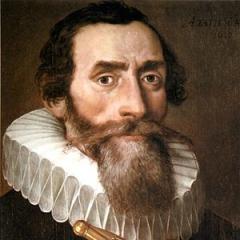
Johannes Kepler
Johannes Kepler

Johannes Kepler was a German astronomer, mathematician, and physicist, renowned for his research on the laws of planetary motion. He formulated the famous Kepler's laws, which describe the regularities of planetary orbits around the sun. Kepler's work had a profound impact on the development of astronomy and physics. more

You May Also Like

“Plants, again, inasmuch as they are without locomotion, present no great variety in their heterogeneous pacts. For, when the functions are but few, few also are the organs required to effect them. ... Animals, however, that not only live but perceive, present a great multiformity of pacts, and this diversity is greater in some animals than in others, being most varied in those to whose share has fallen not mere life but life of high degree. Now such an animal is man.”

“Since my first discussions of ecological problems with Professor John Day around 1950 and since reading Konrad Lorenz's "King Solomon's Ring," I have become increasingly interested in the study of animals for what they might teach us about man, and the study of man as an animal. I have become increasingly disenchanted with what the thinkers of the so-called Age of Enlightenment tell us about the nature of man, and with what the formal religions and doctrinaire political theorists tell us about the same subject.”

“There are various causes for the generation of force: a tensed spring, an air current, a falling mass of water, fire burning under a boiler, a metal that dissolves in an acid-one and the same effect can be produced by means of all these various causes. But in the animal body we recognise only one cause as the ultimate cause of all generation of force, and that is the reciprocal interaction exerted on one another by the constituents of the food and the oxygen of the air. The only known and ultimate cause of the vital activity in the animal as well as in the plant is a chemical process.”

“Darwin's book is very important and serves me as a basis in natural science for the class struggle in history. One has to put up with the crude English method of development, of course. Despite all deficiencies not only is the death-blow dealt here for the first time to 'teleology' in the natural sciences, but their rational meaning is empirically explained.”