“There is a certain degree of temptation which will overcome any virtue. Now, in so far as you approach temptation to a man, you do him an injury; and, if he is overcome, you share his guilt.”
Quote by Samuel Johnson
Work
The life of Samuel Johnson, LL. D., comprehending an account of his studies, and numerous works, in chronological order: a series of his epistolary correspondence and conversations with many eminent persons; and various original pieces of his composition, never before published; the whole exhibiting a view of literature and literary men in Great Britain, for near half a century during which he flourished
This book offers a chronological account of Samuel Johnson's life, highlighting his studies, numerous literary works, and his extensive correspondence and conversations with prominent figures of his time. It provides insight into the literary scene in Great Britain over nearly half a century, showcasing Johnson's influence on literature and his interactions with other notable literary men. more
Author
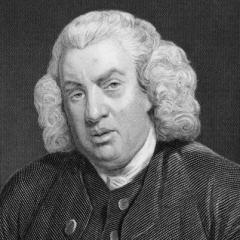
Samuel Johnson
Samuel Johnson was an English writer, poet, and lexicographer, renowned for his comprehensive English dictionary, 'A Dictionary of the English Language', published in 1755. His distinctive writing style and wit have cemented his place as a significant figure in the history of English literature. more
You May Also Like
“Trust as little as you can to report, and examine all you can by your own senses.”
Source: Boswell's Life of Johnson: Including Boswell's Journal of a Tour of the Hebrides, and Johnson's Diary of A Journey Into North Wales
“Every man prefers virtue, when there is not some strong incitement to transgress its precepts.”
Source: The life of Samuel Johnson, LL. D., comprehending an account of his studies, and numerous works, in chronological order: a series of his epistolary correspondence and conversations with many eminent persons; and various original pieces of his composition, never before published; the whole exhibiting a view of literature and literary men in Great Britain, for near half a century during which he flourished
“This world, where much is to be done and little to be known.”
Source: Dr. Johnson's Table Talk: Containing Aphorisms on Literature, Life, and Manners; with Anecdotes of Distinguished Persons, Selected and Arranged from Dr. Boswell's Life of Johnson
Source: The Rambler: In Four Volumes
Source: Dr. Johnson's Table-talk: Containing Aphorisms on Literature, Life, and Manners, with Anecdotes of Distinguished Persons, Selected and Arranged from Mr. Boswell's Life of Johnson
Source: The Works of Samuel Johnson, LL.D.: With An Essay on His Life and Genius
Source: The life of Samuel Johnson, LL. D., comprehending an account of his studies, and numerous works, in chronological order: a series of his epistolary correspondence and conversations with many eminent persons; and various original pieces of his composition, never before published; the whole exhibiting a view of literature and literary men in Great Britain, for near half a century during which he flourished