Quotessence
Home / Quotes / Quote by Truman Capote

Quote by Truman Capote

Work

Retrats

Browse quotes and source details for this work. more

Author

Truman Capote
Truman Capote

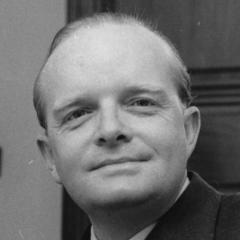
Truman Capote was an American author renowned for his distinctive narrative style and his works that frequently blurred the lines between fiction and non-fiction. His most celebrated novel, 'In Cold Blood,' is a seminal work in American literature, merging elements of true crime with literary fiction. Born on September 30, 1924, Capote passed away on August 25, 1984. more

You May Also Like

“Let us consider a sad illumination. The Manhattan office worker moves througha clutter of factory-made, anonymous furniture to a plastic, impersonal kitchen, tobreakfast on canned, packaged anonymous food-fuel; dresses hirself in theanonymous-city-dweller costume, travels through dark tunnels of sooty metal andgray concrete to a dark metal room, foul with polluted air. All day s/he deals withsymbols that have no relevance to hir divine possibilities. This person issurrounded by the dreary, impersonal, assembly-line, mass-produced, anonymousenvironment of an automated robot, which perfectly mirrors hir “turned off’awareness. When this person “turns on,” s/he sees at once the horror of hir surroundings. Ifs/he “tunes in,” s/he begins to change hir movements and hir surroundings sothat they become more in harmony with hir internal beauty. If everyone inManhattan were to “turn on” and “tune in,” grass would grow on First Avenueand tieless, shoeless divinities would dance or roller-skate down the carlessstreets. Ecological consciousness would emerge within 25 years. Fish would swimin a clear-blue Hudson.”

“— No, no es la naturaleza del hombre. No creeré que la naturaleza del hombre sea más inconstante que la mujer para olvidar a los que se ama o se ha amado. Creo lo contrario. Creo en una analogía entre nuestros cuerpos y nuestras almas; si nuestros cuerpos fuertes, así serán nuestros sentimientos: capaces de soportar el trato más rudo y de capear el temporal más fuerte.”

“Los restos paleontológicos revelan pruebas fascinantes de agresión entre hombres. Se han hallado trozos de lanzas y cuchillos alojados en los restos de cajas torácicas humanas. Las lesiones de cráneo y costillas son más frecuentes en el esqueleto masculino que en el femenino, lo que indica que el combate físico era una actividad fundamentalmente masculina.”