Quotessence
Home / Quotes / Quote by Max Horkheimer

Quote by Max Horkheimer

“When the great religious and philosophical conceptions were alive, thinking people did not extol humility and brotherly love, justice and humanity because it was realistic to maintain such principles and odd and dangerous to deviate from them, or because these maxims were more in harmony with their supposedly free tastes than others. They held to such ideas because they saw in them elements of truth, because they connected them with the idea of logos, whether in the form of God or of a transcendental mind, or even of nature as an eternal principle.”

Quote by Max Horkheimer

Author
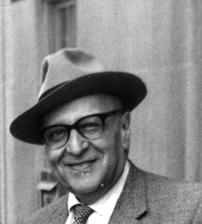
Max Horkheimer
Max Horkheimer

German philosopher and sociologist, one of the founders of the Frankfurt School. Max Horkheimer was born on February 14, 1895, and died on July 7, 1973. He had a profound influence on philosophy, sociology, and critical theory. more

You May Also Like

“Pragmatism , in trying to turn experimental physics into a prototype of all science and to model all spheres of intellectual life after the techniques of the laboratory, is the counterpart of modern industrialism, for which the factory is the prototype of human existence, and which models all branches of culture after production on the conveyor belt.”

“The significance of God, cause, number, substance or soul consists, as James asserts, in nothing but the tendency of the given concept to make us act or think. If the world should reach a point at which it ceases to care not only about such metaphysical entities but also about murders perpetrated behind closed frontiers or simply in the dark, one would have to conclude that the concepts of such murders have no meaning, that they represent no 'distinct ideas' or truths, since they do not make any 'sensible difference to anybody.”

“In the face of the idea that truth might afford the opposite of satisfaction and turn out to be completely shocking to humanity at any given historical moment, ... the fathers of pragmatism made the satisfaction of the subject the criterion of truth. For such a doctrine there is no possibility of rejecting or even criticizing any species of belief that is enjoyed by its adherents.”

“One woman approached me as she walked past and, pointing to her four children who were manfully helping the smallest ones over the rough ground, whispered: 'How can you bring yourself to kill such beautiful, darling children? Have you no heart at all?' One old man, as he passed me, hissed: 'Germany will pay a heavy penance for this mass murder of the Jews.' His eyes glowed with hatred as he said this. Nevertheless he walked calmly into the gas-chamber.”