Quotessence
Home / Quotes / Quote by Oscar Wilde

Quote by Oscar Wilde

“My sweet rose, my delicate flower, my lily of lilies, it is perhaps in prison that I am going to test the power of love. I am going to see if I cannot make the bitter warders sweet by the intensity of the love I bear you. I have had moments when I thought it would be wise to separate. Ah! Moments of weakness and madness! Now I see that would have mutilated my life, ruined my art, broken the musical chords which make a perfect soul. Even covered with mud I shall praise you, from the deepest abysses I shall cry to you. In my solitude you will be with me.”

Quote by Oscar Wilde

Author
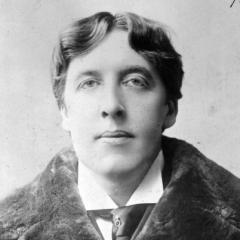
Oscar Wilde
Oscar Wilde

Oscar Wilde, born on October 16, 1854, in Ireland, and died on November 30, 1900, was a renowned Irish writer, playwright, and poet. His works are known for their wit, satire, and unique style, with notable works including 'The Picture of Dorian Gray' and 'Lady Windermere's Fan'. more

You May Also Like

“It was the tenderness mingled with melancholy which we bring to a time that belongs irrevocably to the past, when a pale, delicate shadow rises from it bearing the lilies of the dead, and in it we find a forgotten likeness to ourselves. And that faint, wistful shadow, that pale scent, seemed to vanish away into a wide, full, warm stream - the life that now lay open before him.”

“Ordered by subject, by importance, ordered according to whether the book was penned by God or by one of God's creatures, ordered alphabetically or by numbers or by the language in which the text is written, every library translates the chaos of discovery and creation into a structured system of hierarchies or a rampage of free associations.”

“Going back to school is like going back in time. Immediately, for better or for worse, you must give up a little piece of your autonomy in order to become part of the group. And every group, of course, has its hierarchies and rules- spoken and unspoken. It is like learning to live once again in a family- which, of course, is the setting where all learning begins.”

“In college, in the early 1950s, I began to learn a little about how science works, the secrets of its great success, how rigorous the standards of evidence must be if we are really to know something is true, how many false starts and dead ends have plagued human thinking, how our biases can colour our interpretation of evidence, and how often belief systems widely held and supported by the political, religious and academic hierarchies turn out to be not just slightly in error, but grotesquely wrong.”

“All of us have monarchs and sages for kinsmen; nay, angels and archangels for cousins; since in antediluvian days, the sons of God did verily wed with our mothers, the irresistible daughters of Eve. Thus all generations are blended: and heaven and earth of one kin: the hierarchies of seraphs in the uttermost skies; the thrones and principalities in the zodiac; the shades that roam throughout space; the nations and families, flocks and folds of the earth; one and all, brothers in essence-oh, be we then brothers indeed! All things form but one whole.”

“Of course, we can distinguish between males and females; we can also, if we choose, distinguish between different age categories; but any more advanced distinction comes close to pedantry, probably a result of boredom. A creature that is bored elaborates distinctions and hierarchies. According to Hutchinson and Rawlins, the development of systems of hierarchical dominance within animal societies does not correspond to any practical necessity, nor to any selective advantage; it simply constitutes a means of combating the crushing boredom of life in the heart of nature.”