Quotessence
Home / Quotes / Quote by Amartya Sen

Quote by Amartya Sen

“Women had always been thought of as looking after the family when men go and earn an income and they're the bread earner and so on. So there is a kind of generation of inequality, [and], on top of the fact, women have pregnancies and periods, [and] when the children are very small, there are greater demands on their time. So one way or another women have had a pretty rough deal in the past, and there's no reason why that should continue, and any country that has tried to remedy that has succeeded in doing so.”

Quote by Amartya Sen

Author
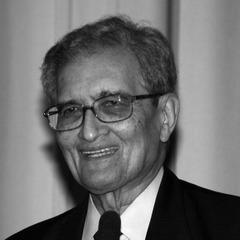
Amartya Sen
Amartya Sen

Amartya Sen is an Indian economist renowned for his contributions to welfare economics, development economics, and ethics. He won the Nobel Prize in Economics in 1979 and is considered one of the most outstanding economists of the 20th century. more

You May Also Like

“There may be countries [where] there's no gender inequality in schooling, even in higher education, but [where there is] gender inequality in high business. Japan is a very good example of that. You might find cases in the United States where at one level women's equality has progressed tremendously. You don't have the kind of problem of higher women's mortality as you see in South Asia, North Africa, and East Asia, China, too, and yet for American women there are some fields in which equality hasn't yet come.”

“The understanding that women are not inferior across the world, it's something that you can get from school, not only from the book but also from chatting with other kids. It's a big impact. One of the curious things is that even when - and this we found from studies - the schools are doing pretty badly in terms of their education, about mathematics and literature and language, going to school transformed people because I think the action of schooling, the activity, is very important.”

“South Korea at the end of the Second World War had a very low level of literacy. But suddenly, like in Japan, they determined they were going in that direction. In 20 years' time, they had transformed themselves. So when people go on saying that it's all because of perennial culture, which you cannot change, that's not the way the South Korean economy was viewed before the war ended. But again within 30 years, people went on saying there's an ancient culture in Korea that has been pro-education, which is true.”