Quotessence
Home / Quotes / Quote by Maximus the Confessor

Quote by Maximus the Confessor

“We must not only put bodily passions to death but also destroy the soul's impassioned thoughts. Hence the Psalmist says, 'Early in the morning I destroyed all the wicked of the earth, that I might cut off all evil-doers from the city of the Lord' (Ps. 101:8) - that is, the passions of the body and the soul's godless thoughts.”

Quote by Maximus the Confessor

Author
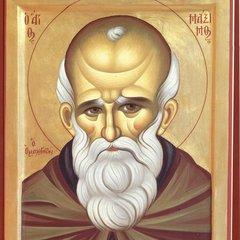
Maximus the Confessor

Maximus the Confessor, who lived from 580 to August 13, 662, was a mysterious religious philosopher and theologian. His life and achievements are not well-documented in historical records, but his thoughts have had a profound impact on Christian philosophy. more

You May Also Like

“The man who has struggled bravely with the passions of the body, has fought ably against unclean spirits, and has expelled from his soul the conceptual images they provoke, should pray for a pure heart to be given him and for a spirit of integrity to be renewed within him (cf. Ps. 51:10). In other words, he should pray that by grace he may be completely emptied of evil thoughts and filled with divine thoughts, so that he may become a spiritual world of God, splendid and vast, wrought from moral, natural and theological forms of contemplation.”

“When our intellect has shaken off its many opinions about created things, then the inner principle of truth appears clearly to it, providing it with a foundation of real knowledge and removing its former preconceptions as though removing scales from eyes, as happened in the case of St. Paul (cf. Acts 9:18). For an understanding of Scripture that does not go beyond the literal meaning, and a view of the sensible world that relies exclusively on sense perception, are indeed scales, blinding the soul's visionary faculty and preventing access to the pure Logos of truth.”

“Those who, animal-like, live solely according to the senses... misuse God's creation in order to indulge the passions. They do not understand the principle of that wisdom which is revealed to all: that we should know and praise God through His creation and that by means of the visible world we should understand whence we came, what we are, for what purpose we were made and where we are going. On the contrary, they travel through this present age in darkness... with... ignorance of God.”

“When like the patriarchs we learn to dig wells of virtue and spiritual knowledge within ourselves by means of ascetic practice and contemplation, we will find within us Christ the spring of life (cf. Gen. 26:15-18). Wisdom commands us to drink from this spring, saying, 'Drink water from your own pitchers and from the spring of your own wells' (Prov. 5:15). If we do this we shall find that the treasures of wisdom truly are within us.”

“If you expound the teaching of the Logos from the standpoint of the moral life, using materialistic words and examples which correspond to the capacity of your hearers, you make the Logos flesh. Conversely, if you elucidate mystical theology by means of the higher forms of contemplation you make the Logos spirit.”

“When we think of the height of God's infinity we should not despair of His compassion reaching us from such a height; and when we recall the infinite depth of our fall through sin we should not refuse to believe that the virtue which has been killed in us will rise again. For God can accomplish both these things: He can come down and illumine our intellect with spiritual knowledge, and He can raise up the virtue within us and exalt it with Himself through works of righteousness.”