Quotessence
Home / Quotes / Quote by Aldous Huxley

Quote by Aldous Huxley

“But man now behaves like the Pharisees and insists that he is made for all the things—science, industry, nation, money, religion, schools—which were really made for him. Why? Because he is so little aware of his own interests as a human being that he feels irresistibly tempted to sacrifice himself to these idols. There is no remedy except to become aware of one's interests as a human being, and, having become aware, to learn to act on that awareness. Which means learning to use the self and learning to direct the mind. It's almost wearisome, the way one always comes back to the same point. Wouldn't it be nice, for a change, if there were another way out of our difficulties! A short cut. A method requiring no greater personal effort than recording a vote or ordering some 'enemy of society' to be shot. A salvation from outside, like a dose of calomel.”

Quote by Aldous Huxley

Work

Eyeless In Gaza

This book is a fictional account of life in the Gaza Strip during the 1970s, focusing on the struggles and resilience of its inhabitants amidst the backdrop of war and conflict. more

Author
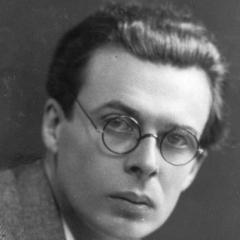
Aldous Huxley
Aldous Huxley

Aldous Huxley was an English writer and philosopher, renowned for his dystopian novel 'Brave New World'. Born on July 26, 1894, in Godalming, Surrey, England, he was the younger brother of the poet and critic Leonard Huxley. Huxley's works frequently delved into the interplay of science, politics, and philosophy, and he was a prominent figure in the literary movement known as the 'Lost Generation'. He passed away on November 22, 1963. more

You May Also Like

“Emotional intelligence is knowledge of the “Self,” understanding who we are, and employing this knowledge to exercise self-control in our relationships with other beings and the world. Only by knowing ourselves can we responsibly and efficiently manage our senses, thoughts, words and actions, and behave in a benevolent manner toward other beings and the world.”

“We must engage our sense of self to sensibly deal with environmental stresses in the ever-changing world. Without a strong sense of self and an equally robust ego, I might have expired long ago. Because I possess a brain that is capable of self-recognition and self-regulation, I reserve the opportunity to edit personal behavior. If I can exercise the necessary self-discipline, I can reposition an individualistic and egotistical sense of self-identity. A sense of self can lock us into self-destructive behavioral patterns. If we exhibit an inflexible sense of self, we are predisposed to act in a rigidly prescribed manner. Some of our personal decisions might not support our long-term best interest. The Neanderthals failed to adapt to environmental changes and paid the ultimate price with extermination of their species. I too face the challenge of either adapting to environmental stresses or expiring. My prior characterization of self-identity did not serve me well since it brought me to the brink of self-immolation. Accordingly, I must revise whom I think I am in order to adapt to the challenges of a rapidly changing environment by assessing who I was, determining who I want to become, and developing a disciplined approach to make the transition from what I was to who I seek to become.”

“We determine who we are during all acts of survival. Self-identity is an ongoing process of self-exploration and development of strength of character. Human pain is unavoidable. A person finds their immaculate core floating amongst the rubble of ruined dreams and imploded fantasies. With strength of mind and time tested character, a prudent person begins recasting a person’s quixotic outlook upon life into mature philosophy that will gird them against all the heartaches and tragedies of an earthly life.”

“Children, teenagers, and young adults frequently attempt to duplicate their cult hero’s mannerisms. Sometimes when we observe youngsters attempting to emulate the gestures and behaviors of a celebrity whom they admire, we state that they are putting on airs or engaging in pretensions. Adults tend to fob off such pretentious behavior as a frivolous act engaged in by children. In actuality, pretentious behavior is an important learning rubric for behavior and character formation. Imitation is more than a form of flattery. When young people mimic admired celebrities they are displaying telling behavior regarding what subjects spikes their interest and this in turn might provide clues to their future vocational and recreational activities. By engaging in mimicry, we are able to audition our future self. Just as many athletes begin in their youth attempting to impersonate the style of their sports idols, young people universally attempt to copy the mannerisms and behaviorisms of people whom they respect. Mimicry is one way that people feel safe exploring what persona they wish to adopt. How many rock stars and other successful people endorsed the mantra, ‘Fake it ‘till you make it.”

“Our evolving self-concept guides our daily actions, organizes our information processing, and fosters a stout mental predisposition that assists our ego maintain a fibrous self-image. Self-concept is not restricted to a bare assessment of what role we presently fulfill in society. Our self-image is an endogenous alloy that includes an agglomeration of past selves and possible future selves. Future selves or ‘possible selves’ represent a person’s ideas of what they might become, what they aspire to become, and what they are afraid of becoming.”

“Our emotional valence – positive or negative experiences – affects not only how we narrate childhood events, but also which memories we retain. The interplay between a person encountering environment experiences meshed with self-editing of various aspects of their complex memory system results in a person becoming more than a collection of memories: a person creates their personalized version of a self. A person integrates many experiences into creating their being. Personal encounters with other people as well as moments of personal solitude contemplating ideas and personal existence congeal to form the depiction of a self.”

“Personal memory – the palest of all lights – is the wellspring of personality and creativity. Memory is the also the cornerstone of culture and the basis of community and family relationships. Without memories of our thoughts and actions, we would not recognize our individual self. Without personal memories, there is no personal character or soul of a nation. Without contextual memories, the concept of universal principles of goodwill and the individual desire to perform noble selfless acts would be moot. There can be no symmetry in any human relations without memories to provide a baseline foundation for reflection and contemplation. It would fatally tax a person’s desire to achieve fairness in their personal dealings without memories of prior acts of greed or benevolence to provide structure for judging the merits of their current behavioral options. Without the haunting of memory to remind us of our propensity to hate outsiders and readiness to overlook the disfranchised, there would be wholesale discrimination and unchecked commission of infamous crimes.”