Quotessence
Home / Quotes / Quote by Richard Lewontin

Quote by Richard Lewontin

“My general impression about people like Steve Gould and Carl Sagan and so on is that when they disappear as individuals and are no longer appearing on the stage and they are no longer writing, that their lifetime of acknowledgement by the general reading public is not very long... There were many people in the 19th century who were equally famous people who gave working man's lectures, supporters of Darwin, we as scholars know their names but the general public never heard of them.”

Quote by Richard Lewontin

Author
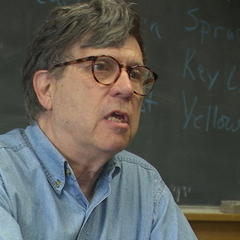
Richard Lewontin
Richard Lewontin

Richard Lewontin, born on March 29, 1929, is an esteemed evolutionary biologist. His research has focused on genetics, molecular biology, and evolutionary theory, profoundly influencing the development of modern biology. more

You May Also Like

“I write my first draft by hand, at least for fiction. For non-fiction, I write happily on a computer, but for fiction I write by hand, because I'm trying to achieve a kind of thoughtless state, or an unconscious instinctive state. I'm not reading what I write when I wrote. It's an unconscious outpouring that's a mess, and it's many, many steps away from anything anyone would want to read. Creating that way seems to generate the most interesting material for me to work with, though.”

“The general public doesn't know and probably doesn't care about punctuated equilibria nor indeed should they, or the greenhouse effect on some other planet - they barely have the ability to cope with the greenhouse effect on their own planet. So I think you have to distinguish between the broad visibility of a scientist when he or she is speaking to a general public and trying to address general issues and the continued position that a scientist may have into the history of a particular subject.”

“Scientists are educated from a very early time and a very early age to believe that the greater scientist is the scientist who makes discoveries or theories that apply to the greatest ambit of things in the world. And if you've only made a very good theory about snails, or a very good theory about some planets but not about the universe as a whole, or about all the history of humankind, then you have in some sense accepted a lower position in the hierarchy of the fame of science as it's taught to you as a young student.”

“The average person might articulate them differently, but we all think about interpersonal relationships in one way or another. Writers just express that in different ways and capture it in different ways. To some degree, we're all thinking about the same things. It's the zeitgeist. The trick, in a way, as a writer, is to hope that your interests in some sense link up with the culture around you.”

“If I ask you who is the most famous scientist who ever lived, or the greatest scientist who ever lived you'll say either Einstein or Newton or something like that because their claims were supposed to apply universally. But the claim of somebody who is studying a particular feature of the evolutionary process like whether it's very fast or very slow, or occurs in steps and so on, that's not a universal claim, that's a rather specialised claim and so you can't claim to great fame and great success.”