Quotessence
Home / Quotes / Quote by Carl Sagan

Quote by Carl Sagan

Work

Broca's brain: reflections on the romance of science

This book delves into the fascinating world of neuroscience, examining the evolution of scientific understanding of the brain and its intricate workings. The author combines historical accounts with personal reflections, offering a unique perspective on the romance and challenges of scientific discovery. more

Author
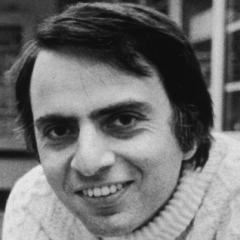
Carl Sagan
Carl Sagan

Carl Sagan was an American astronomer, cosmologist, author, and science communicator, born on November 9, 1934, in Brooklyn, New York. He is renowned for his profound research into the cosmos and his dedication to popularizing science. Sagan proposed numerous theories about the origin of the universe and life, and he made complex scientific knowledge accessible to the public with his unique perspective and clear, engaging writing style. more

You May Also Like

“Despite the campaign rhetoric, the bureaucracies-big business and big government-are here to stay. The centralization effort cannot be checked. but it can be rationally directed towards our species goal: Space Migration, which in turn offers the only way to re-attain individual freedom of space-time and the small-group social structures which obviously best suit our nervous systems. It is another paradox of neuro-genetics that only in space habitats can humanity return to the village life and pastoral style for which we all long.”

“Sooner or later for good or ill, a united mankind, equipped with science and power, will probably turn its attention to the other planets, not only for economic exploitation, but also as possible homes for man. . . . The goal for the solar system would seem to be that it should become an interplanetary community of very diverse worlds . . . . Through the pooling of this wealth of experience, through this 'commonwealth of worlds,' new levels of mental and spiritual development should become possible, levels at present quite inconceivable to man.”

“It is in the long run essential to the growth of any new and high civilization that small groups of men can escape from their neighbors and from their government, to go and live as they please in the wilderness. A truly isolated, small, and creative society will never again be possible on this planet.”

“Until now in world's history, whenever we've had a dark age, its been temporary and local. And other parts of the world have been doing fine. And eventually, they help you get out of the dark age. We are now facing a possible dark age which is going to be world-wide and permanent! That's not fun. That's a different thing. But once we have established many worlds, we can do whatever we want as long as we do it one world at a time.”

“There are three reasons, . . . apart from scientific considerations, mankind needs to travel in space. The first . . . is garbage disposal; we need to transfer industrial processes into space so that the earth may remain a green and pleasant place for our grandchildren to live in. The second . . . to escape material impoverishment: the resources of this planet are finite, and we shall not forego forever the abundance of solar energy and minerals and living space that are spread out all around us. The third . . . our spiritual need for an open frontier.”

“But space travel can't ease the pressure on a planet grown too crowded not even with today's ships and probably not with any future ships-because stupid people won't leave the slopes of their home volcano even when it starts to smoke and rumble. What space travel does do is drain off the best brains: those smart enough to see a catastrophe before it happens, and with the guts to pay the price-abandon home, wealth, friends, relatives, everything-and go. That's a tiny fraction of one percent. But that's enough.”