Quotessence
Home / Quotes / Quote by Pope Benedict XVI

Quote by Pope Benedict XVI

Author

Pope Benedict XVI
Pope Benedict XVI

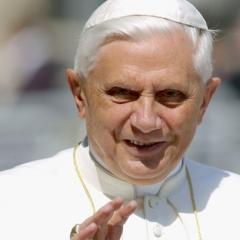
Pope Benedict XVI, born Joseph Aloisius Ratzinger, was the 265th Pope of the Roman Catholic Church, serving from 2005 to 2013. He had a deep academic background in philosophy and theology, serving as a Cardinal and President of the Pontifical Biblical Commission. During his papacy, Pope Benedict XVI worked to promote church reform and dialogue, emphasizing the importance of traditional doctrine while balancing conservative and reformist forces within the church. more

You May Also Like

“Ten looked confounded that anyone would consider the world’s most slavishly adored hot beverage in such a way. Julia felt momentarily sorry for him. He seemed like a guy who’d had it all figured out – join a band and get himself laid every night of the week. Living the dream. He had no fucking clue what was ahead of him.”

“It comes from history. It comes from the record of the Inquisition, persecuting heretics and torturing Jews and all that sort of stuff; and it comes from the other side, too, from the Protestants burning the Catholics. It comes from the insensate pursuit of innocent and crazy old women, and from the Puritans in America burning and hanging the witches — and it comes not only from the Christian church but also from the Taliban. Every single religion that has a monotheistic god ends up by persecuting other people and killing them because they don't accept him. Wherever you look in history, you find that. It’s still going on.”

“Hitherto, the Palestinians had been relatively immune to this Allahu Akhbar style. I thought this was a hugely retrograde development. I said as much to Edward. To reprint Nazi propaganda and to make a theocratic claim to Spanish soil was to be a protofascist and a supporter of 'Caliphate' imperialism: it had nothing at all to do with the mistreatment of the Palestinians. Once again, he did not exactly disagree. But he was anxious to emphasize that the Israelis had often encouraged Hamas as a foil against Fatah and the PLO. This I had known since seeing the burning out of leftist Palestinians by Muslim mobs in Gaza as early as 1981. Yet once again, it seemed Edward could only condemn Islamism if it could somehow be blamed on either Israel or the United States or the West, and not as a thing in itself. He sometimes employed the same sort of knight's move when discussing other Arabist movements, excoriating Saddam Hussein's Ba'ath Party, for example, mainly because it had once enjoyed the support of the CIA. But when Saddam was really being attacked, as in the case of his use of chemical weapons on noncombatants at Halabja, Edward gave second-hand currency to the falsified story that it had 'really' been the Iranians who had done it. If that didn't work, well, hadn't the United States sold Saddam the weaponry in the first place? Finally, and always—and this question wasn't automatically discredited by being a change of subject—what about Israel's unwanted and ugly rule over more and more millions of non-Jews? I evolved a test for this mentality, which I applied to more people than Edward. What would, or did, the relevant person say when the United States intervened to stop the massacres and dispossessions in Bosnia-Herzegovina and Kosovo? Here were two majority-Muslim territories and populations being vilely mistreated by Orthodox and Catholic Christians. There was no oil in the region. The state interests of Israel were not involved (indeed, Ariel Sharon publicly opposed the return of the Kosovar refugees to their homes on the grounds that it set an alarming—I want to say 'unsettling'—precedent). The usual national-security 'hawks,' like Henry Kissinger, were also strongly opposed to the mission. One evening at Edward's apartment, with the other guest being the mercurial, courageous Azmi Bishara, then one of the more distinguished Arab members of the Israeli parliament, I was finally able to leave the arguing to someone else. Bishara [...] was quite shocked that Edward would not lend public support to Clinton for finally doing the right thing in the Balkans. Why was he being so stubborn? I had begun by then—belatedly you may say—to guess. Rather like our then-friend Noam Chomsky, Edward in the final instance believed that if the United States was doing something, then that thing could not by definition be a moral or ethical action.”

“Surely we can only come to understand each other's beliefs by means of direct encounter and open, honest discussion. In the meantime, many free churches invite all believers in Jesus Christ to the Table for the sake of true spiritual unity that transcends intellectual differences of interpretation. Withholding sacramental sharing on the basis of disagreement about the nature of the Lord's Supper seems odd to us. What two people think exactly alike about the act? We are not offended by Catholics' closed Communion, but we find it odd and exclusive. It places intellectual understanding above fellowship among disciples of Jesus Christ.”

“What was critical to my father was that we not "go into government". His father and mother had both worked in the Treasury Department; and to him, "going into government" meant getting "hooked" on the salary and job security, and spending the rest of one's life in predictable, routinized labor that stunted the mind and sapped the spirit. My father would tell us of accountant friends who had passed their C.P.A. exam, then gone to work for the generous starting salaries offered by the I.R.S. While he was struggling in his mid-twenties, they were bragging about the cash they were taking home. Now, he said, he rarely saw them. Now, they had a defeated look; now, they were taking orders from some bureaucrat, and would be taking orders for the rest of their lives. He admired the disposition to roll the dice and risk everything that his Jewish friends and clients, Benny Ouresman, the Chevrolet dealer, and Harry Viner and his son Melvin, who had made a fortune with Sunshine Laundry, had exhibited. "They didn't have a damn dime when they started," Pop would tell us, emphatically. "They went to friends, borrowed money, started a business, went broke, went back to their friends, borrowed again, went broke again. Finally, they made it. They built something of their own. Now they work for themselves, and everybody else works for them. Be your own man!" That was the attitude we should adopt.”