Quotessence
Home / Quotes / Quote by Carl Sandburg

Quote by Carl Sandburg

Work

Selected poems

This book compiles a selection of poems that showcase the depth and diversity of the author's poetic voice, exploring a range of subjects and employing different literary techniques. more
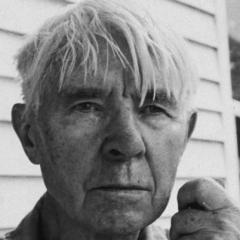
Author

Carl Sandburg
Carl Sandburg

Carl Sandburg was a prominent American poet, writer, journalist, and editor. Born on January 6, 1878, in Illinois, he passed away on July 22, 1967. His works primarily depicted rural life in America, industrialization, and the working class, with notable works including 'Chicago' and 'The American Songbag'. more

You May Also Like

“The well from which we draw our love to give to other people, should never be only as deep as the well wherein resides the love we have already received in our lives. The cycle must be broken. The former well must be abandoned and we must create a love in our hearts for others, from the bricks and the mortar of our own visions. Our raw materials must come not only from what we received; but our raw materials must come from what we envision to create. From your desires and your visions— your bricks and mortar should materialize. And if your former well is completely empty and dry— so what— you don't owe it to your past, to the people who hurt you, to make that emptiness and that void, your place for drawing water from!”

“Kwa sababu za kijiografia, Copenhagen iko mbele kwa masaa 9 (PST) kuilinganisha na Tijuana (kaskazini-magharibi mwa Meksiko) na masaa 7 (CST) kuilinganisha na Salina Cruz (kusini-magharibi mwa Meksiko). Mauaji ya Meksiko yametokea saa 4 usiku wa Jumanne, Copenhagen ikiwa saa 1 asubuhi Jumatano CET. Saa 5 usiku wa Jumanne, El Tigre anahamishwa (na ndege binafsi) kutoka katika milima ya Tijuana (alikokuwa amejificha) mpaka katika jumba la kifahari la Eduardo Chapa de Christopher (Mkurugenzi wa Usafirishaji wa Kolonia Santita) nje ya Salina Cruz – ambako Chui anafika saa 10 alfajiri na kuendesha kikao cha dharura cha Bodi ya Wakurugenzi ya Kolonia Santita.”

“To understand anything is to find in it something which is our own, and it is the discovery of ourselves outside us which makes us glad. This relation of understanding is partial, but the relation of love is complete. In love the sense of difference is obliterated and the human soul fulfils its purpose in perfection, transcending the limits of itself and reaching across the threshold of the infinite. Therefore love is the highest bliss that man can attain to, for through it alone he truly knows that he is more than himself, and that he is at one with the All.”

“The bistro was his secret weapon in tracking down murderers. Not just in Three Pines, but in every town and village in Quebec. First he found a comfortable café or brasserie, or bistro, then he found the murderer. Because Armand Gamache knew something many of his colleagues never figured out. Murder was deeply human, the murdered and the murderer. To describe the murderer as a monstrosity, a grotesque, was to give him an unfair advantage. No. Murderers were human, and at the root of each murder was an emotion. Warped, no doubt. Twisted and ugly. But an emotion. And one so powerful it had driven a man to make a ghost. Gamache's job was to collect the evidence, but also to collect the emotions. And the only way he knew to do that was do get to know the people. To watch and listen. To pay attention, and the best way to do that was in a deceptively casual way in a deceptively casual setting. Like the bistro.”