Quotessence
Home / Quotes / Quote by Isaac Asimov

Quote by Isaac Asimov

“I received the fundamentals of my education in school, but that was not enough. My real education, the superstructure, the details, the true architecture, I got out of the public library. For an impoverished child whose family could not afford to buy books, the library was the open door to wonder and achievement, and I can never be sufficiently grateful that I had the wit to charge through that door and make the most of it.”

Quote by Isaac Asimov

Work

I, Asimov: A Memoir

In this memoir, Isaac Asimov reflects on his life, sharing anecdotes and personal experiences that shaped his career as a science fiction writer and his contributions to the field of science. more

Author

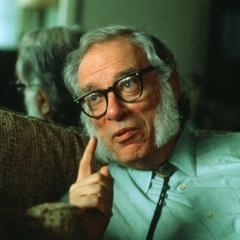
Isaac Asimov
Isaac Asimov

Isaac Asimov, born on January 2, 1920 in Poland and died on April 6, 1992 in the United States, was a renowned American science fiction author, science writer, and literary critic, known as the 'Father of Science Fiction'. His works covered a wide range of science fiction themes, including robots, space exploration, and time travel, and had a profound impact on science fiction literature and the popularization of science. more

You May Also Like

“If they embark on this course the difference between the old and the new education will be an important one. Where the old initiated, the new merely 'conditions'. The old dealt with its pupils as grown birds deal with young birds when they teach them to fly; the new deals with them more as the poultry-keeper deals with young birds- making them thus or thus for purposes of which the birds know nothing. In a word, the old was a kind of propagation-men transmitting manhood to men; the new is merely propaganda.”

“I believe that the community's duty to education is, therefore, its paramount moral duty. By law and punishment, by social agitation and discussion, society can regulate and form itself in a more or less haphazard and chance way. But through education society can formulate its own purposes, can organize its own means and resources, and thus shape itself with definiteness and economy in the direction in which it wishes to move.”

“I believe that the school is primarily a social institution. Education being a social process, the school is simply that form of community life in which all those agencies are concentrated that will be most effective in bringing the child to share in the inherited resources of the race, and to use his own powers for social ends. I believe that education, therefore, is a process of living and not a preparation for future living.”

“I believe that the teacher's place and work in the school is to be interpreted from this same basis. The teacher is not in the school to impose certain ideas or to form certain habits in the child, but is there as a member of the community to select the influences which shall affect the child and to assist him in properly responding to these influences.”

“The policy of letting the child 'do what he likes' is an insidious one, since the children are encouraged to continue always at their original superficial level, without receiving guidance in study. Furthermore, the 'three Rs,' the fundamental tools, are neglected as long as possible, with the result that the child's chance to develop his mind is greatly retarded. The policy of teaching words via pictures instead of by the alphabet tends to deprive the young child of the greatest reasoning tool of all.”

“Dogma is actually the only thing that cannot be separated from education. It IS education. A teacher who is not dogmatic is simply a teacher who is not teaching. There are no uneducated people; only most people are educated wrong. The true task of culture today is not a task of expansion, but of selection-and-rejection. The educationist must find a creed and teach it.”

“Children are prepared for democracy by being led to discuss current events without first learning the systematic subjects (politics, economics, history) which are necessary in order to discuss them. The Mole effect is to substitute slogans and superficial opinion for considered individual thought. And the opinion is that of the lowest common denominator of the group.”