Quotessence
Home / Quotes / Quote by Bertrand Russell

Quote by Bertrand Russell

Work

The basic writings of Bertrand Russell, 1903-1959

The Basic Writings of Bertrand Russell, 1903-1959 is a compilation of key essays, lectures, and philosophical treatises by Bertrand Russell, one of the most influential thinkers of the 20th century. The volume spans his career, showcasing his insights on logic, mathematics, philosophy, and social issues. It includes seminal works such as 'The Principles of Mathematics' and 'An Outline of the History of Western Philosophy,' offering readers a comprehensive view of Russell's intellectual journey. more

Author
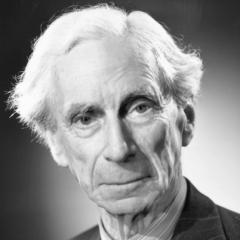
Bertrand Russell
Bertrand Russell

Bertrand Russell was a British philosopher, mathematician, and logician born on May 18, 1872, and died on February 2, 1970. He is known for his contributions to logic and mathematics, particularly in the fields of mathematical logic and philosophical analysis. His works spanned a wide range of subjects, including ethics, political philosophy, history, and literary criticism. more

You May Also Like

“At the age of eleven, I began Euclid, with my brother as my tutor. This was one of the great events of my life, as dazzling as first love. I had not imagined there was anything so delicious in the world. From that moment until I was thirty-eight, mathematics was my chief interest and my chief source of happiness.”

“When a distinguished but elderly scientist states that something is possible, he is almost certainly right. When he states that something is impossible, he is very probably wrong. Perhaps the adjective 'elderly' requires definition. In physics, mathematics, and astronautics it means over thirty; in the other disciplines, senile decay is sometimes postponed to the forties. There are, of course, glorious exceptions; but as every researcher just out of college knows, scientists of over fifty are good for nothing but board meetings, and should at all costs be kept out of the laboratory!”

“The point of mathematics is that in it we have always got rid of the particular instance, and even of any particular sorts of entities. So that for example, no mathematical truths apply merely to fish, or merely to stones, or merely to colours. So long as you are dealing with pure mathematics, you are in the realm of complete and absolute abstraction. . . . Mathematics is thought moving in the sphere of complete abstraction from any particular instance of what it is talking about.”

“Can the difficulty of an exam be measured by how many bits of information a student would need to pass it? This may not be so absurd in the encyclopedic subjects but in mathematics it doesn't make any sense since things follow from each other and, in principle, whoever knows the bases knows everything. All of the results of a mathematical theorem are in the axioms of mathematics in embryonic form, aren't they?”