Quotessence
Home / Quotes / Quote by Eusebius

Quote by Eusebius

Work

The Life of the Blessed Emperor Constantine: From 306 to AD 337

Browse quotes and source details for this work. more

Author
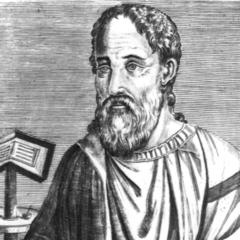
Eusebius
Eusebius

Eusebius (263-339 AD) was a prominent ancient historian known for his significant contributions to the history of Christianity. His most notable work, 'The Church History', is a foundational text for the study of early Christianity. more

You May Also Like

“But how do you know He *doesn't* want us to have it—the cross, I mean? I bet He’s just waiting for one of us to go and find it—just at this moment when it’s most needed. Just at this moment when everyone is forgetting it and chattering about the hypostatic union, there’s a solid chunk of wood waiting for them to have their silly heads knocked against. I’m going off to find it,”

“Too often scholars have thought and even suggested that what happened during and after Constantine was that the church sought to replace the pagan temples, priests, and sacrifices with their own. This is at best a half truth. If this had been primarily what was going on, we would have expected to find priestesses showing up in the mainstream church in and after the time of Constantine, since there were certainly priestesses in the pagan temples. But this we do not find in the historical record. This is because the church of that period was not merely trying to supplant pagan religion with Christian religion, though some of that was going on. More to the point, there was a rising tide of anti-Judaism, and one of its manifestations was this Old Testament hermeneutic. The Torah had been claimed as the church’s book, Jews were being ostracized and then later ghettoized, and a hermeneutic of ministry was being adopted which co-opted the Old Testament for church use when it came to priests, temples, and sacrifices, and indeed sacraments in general. Thus ironically enough while the structure of the ecclesial church was becoming more Old Testamental, the church hierarchy was not only becoming less tolerant of Jews, it was forgetting altogether the Jewish character of Jesus’ ministry and his modifications of the Passover that led to the Lord’s Supper celebration of the early church in the first place.”