Quotessence
Home / Quotes / Quote by Willard Van Orman Quine

Quote by Willard Van Orman Quine

Work

The Ways of Paradox, and Other Essays

This book is a compilation of philosophical essays that delve into intricate concepts and paradoxes, offering readers a deep exploration of philosophical thought. more

Author
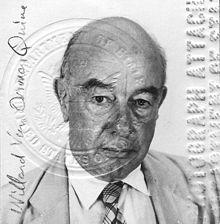
Willard Van Orman Quine

Willard Van Orman Quine was an American philosopher known for his work in logic, philosophy of science, and philosophy of language. He is considered one of the leading analytic philosophers of the 20th century. more

You May Also Like

“The traditional boundaries between various fields of science are rapidly disappearing and what is more important science does not know any national borders. The scientists of the world are forming an invisible network with a very free flow of scientific information - a freedom accepted by the countries of the world irrespective of political systems or religions. ... Great care must be taken that the scientific network is utilized only for scientific purposes - if it gets involved in political questions it loses its special status and utility as a nonpolitical force for development.”

“Twice in my life I have spent two weary and scientifically profitless years seeking evidence to corroborate dearly loved hypotheses that later proved to be groundless; times such as these are hard for scientists-days of leaden gray skies bringing with them a miserable sense of oppression and inadequacy.”

“[May] this civic and social landmark [the Washington, D.C., Jewish Community Center] ... be a constant reminder of the inspiring service that has been rendered to civilization by men and women of the Jewish faith. May [visitors] recall the long array of those who have been eminent in statecraft, in science, in literature, in art, in the professions, in business, in finance, in philanthropy and in the spiritual life of the world.”

“Learning is like mercury, one of the most powerful and excellent things in the world in skillful hands; in unskillful, the most mischievous.”

“The chief art of learning, as Locke has observed, is to attempt but little at a time. The widest excursions of the mind are made by short flights frequently repeated; the most lofty fabrics of science are formed by the continued accumulation of single propositions.”