Quotessence
Home / Quotes / Quote by Robert Musil

Quote by Robert Musil

“The thought is not something that observes an inner event, but, rather it is this inner event itself. We do not reflect on something, but, rather, something thinks itself in us.”

Quote by Robert Musil

Author
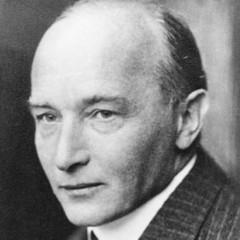
Robert Musil
Robert Musil

Robert Musil, born on November 6, 1880, and died on April 15, 1942, was one of the greatest German novelists of the 20th century. He is renowned for his profound psychological portrayals and philosophical reflections in his works. more

You May Also Like

“I do not at all believe in human freedom in the philosophical sense... Schopenhauer’s saying, ‘A man can do what he wants, but not will what he wants,’ has been a very real inspiration to me since my youth; it has been a continual consolation in the face of life’s hardships, my own and others’, and an unfailing wellspring of tolerance. This realization mercifully mitigates the easily paralyzing sense of responsibility and prevents us from taking ourselves and other people too seriously; it is conducive to a view of life which, in part, gives humour its due.”

“We laugh at a man who, stepping out of his room at the very minute when the sun is rising, says, “It is my will that the sun shall rise”; or at him who, unable to stop a wheel, says, “I wish it to roll”; or, again, at him who, thrown in a wrestling match, says, “Here I lie, but here I wish to lie.” But, joking apart, do we not act like one of these three persons whenever we use the expression “I wish”?”

“Man is an onion made up of a hundred integuments, a texture made up of many threads. The ancient Asiatics knew this well enough, and in the Buddhist Yoga an exact technique was devised for unmasking the illusion of the personality. The human merry-go-round sees many changes: the illusion that cost India the efforts of thousands of years to unmask is the same illusion that the West has labored just as hard to maintain and strengthen.”

“...Haller's sickness of the soul, as I now know, is not the eccentricity of a single individual, but the sickness of the times themselves, the neurosis of that generation to which Haller belongs, a sickness, it seems, that by no means attacks the weak and worthless only but, rather, precisely those who are strongest in spirit and richest in gifts.”

“It was the essence of life to disbelieve in death for one's self, to act as if life would continue forever. And life had to act also as if little issues were big ones. To take a realistic attitude toward life and death meant that one lapsed into unreality. Into insanity. It was ironic that the only way to keep one's sanity was to ignore that one was in an insane world or to act as if the world were sane.”