Quotessence
Home / Quotes / Quote by Jimmy Carter

Quote by Jimmy Carter

“The bottom line is this: Peace will come to Israel and the Middle East only when the Israeli government is willing to comply with international law, with the Roadmap for Peace, with official American policy, with the wishes of a majority of its own citizens--and honor its own previous commitments--by accepting its legal borders. All Arab neighbors must pledge to honor Israel's right to live in peace under these conditions. The United States is squandering international prestige and goodwill and intensifying global anti-American terrorism by unofficially condoning or abetting the Israeli confiscation and colonization of Palestinian territories.”

Quote by Jimmy Carter

Work

Palestine: Peace Not Apartheid

This book delves into the complexities of the Israeli-Palestinian conflict, offering an in-depth examination of the author's views on the peace process and the application of apartheid concepts to the situation in Palestine. more

Author
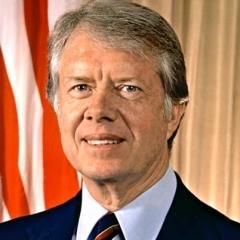
Jimmy Carter
Jimmy Carter

Jimmy Carter, born on October 1, 1924, was the 39th President of the United States, serving from 1977 to 1981. His presidency was characterized by a focus on human rights and international diplomacy, reflecting his dedication to peace and social justice. Post-presidency, Carter has been active in the non-profit sector, notably through the Carter Center, which he founded to promote peace and health worldwide. more

You May Also Like

“As a Nobel Peace laureate, I, like most people, agonize over the use of force. But when it comes to rescuing an innocent people from tyranny or genocide, I've never questioned the justification for resorting to force. That's why I supported Vietnam's 1978 invasion of Cambodia, which ended Pol Pot's regime, and Tanzania's invasion of Uganda in 1979, to oust Idi Amin. In both cases, those countries acted without U.N. or international approval—and in both cases they were right to do so.”

“Wie ich heimschritt bemerkte ich mit einemmal vor mir meinen eigenen Schatten so wie ich den Schatten des anderen Krieges hinter dem jetzigen sah. Er ist durch all diese Zeit nicht mehr von mir gewichen dieser Schatten er überhing jeden meiner Gedanken bei Tag und bei Nacht vielleicht liegt sein dunkler Umriß auch auf manchen Blättern dieses Buches. Aber jeder Schatten ist im letzten doch auch Kind des Lichts und nur wer Helles und Dunkles Krieg und Frieden Aufstieg und Niedergang erfahren nur der hat wahrhaft gelebt.”

“We are thankful to come here for rest, sir," said Jenny. "You see, you don't know what the rest of this place is to us; does he, Lizzie? It's the quiet, and the air." "The quiet!" repeated Fledgeby, with a contemptuous turn of his head towards the City's roar. "And the air!" with a "Poof!" at the smoke. "Ah!" said Jenny. "But it's so high. And you see the clouds rushing on above the narrow streets, not minding them, and you see the golden arrows pointing at the mountains in the sky from which the wind comes, and you feel as if you were dead." The little creature looked above her, holding up her slight transparent hand. "How do you feel when you are dead?" asked Fledgeby, much perplexed. "Oh, so tranquil!" cried the little creature, smiling. "Oh, so peaceful and so thankful! And you hear the people who are alive, crying, and working, and calling to one another down in the close dark streets, and you seem to pity them so! And such a chain has fallen from you, and such a strange good sorrowful happiness comes upon you!" Her eyes fell on the old man, who, with his hands folded, quietly looked on. "Why it was only just now," said the little creature, pointing at him, "that I fancied I saw him come out of his grave! He toiled out at that low door so bent and worn, and then he took his breath and stood upright, and looked all round him at the sky, and the wind blew upon him, and his life down in the dark was over!—Till he was called back to life," she added, looking round at Fledgeby with that lower look of sharpness. "Why did you call him back?" "He was long enough coming, anyhow," grumbled Fledgeby. "But you are not dead, you know," said Jenny Wren. "Get down to life!" Mr Fledgeby seemed to think it rather a good suggestion, and with a nod turned round. As Riah followed to attend him down the stairs, the little creature called out to the Jew in a silvery tone, "Don't be long gone. Come back, and be dead!" And still as they went down they heard the little sweet voice, more and more faintly, half calling and half singing, "Come back and be dead, Come back and be dead!”

“Ah, my dear friend, cheer up... After all, we have peace! And because there is peace, the occupiers can't behave so abominably anymore. All right, we're not free. But we are used to that, Mr. Kujawski. After all we were both born into slavery, and we will die in it. Oh yes, at first they'll exploit us ruthlessly. Fourteen hours of slave labor a day. A bowl of watery soup. Whippings, beatings... But that will pass with time. Because there is peace, they won't have a chance to get any new slaves. They'll have to take good care of those have already. Cheer up, dear Mr. Kujawski... [...] Arbeit macht frei, work makes man free, and it makes him especially so in the sunshine of European peace. We will lack only one thing. Only one! The right of dissent. The right to say out loud that we want a free and independent Poland, that we want to brush our teeth and go on holiday in our own way, conceive children and work our own way, think in our own way, live and die. This is the one thing you will find missing in the sunshine of European peace, which you, my friend, hold to be the highest good.”

“I walked with my eyes on the path, but out of the corners of them I saw a man hiding behind an olive tree. He did not move as we approached, but I fell that he was watching us. As soon as we had passed I heard a scamper. Wilson, like a hunted animal, had made for safely. That was the last I ever saw of him. He died last year. He had endured that life for six years. He was found one morning on the mountainside lying quite peacefully as though he had died in his sleep. From where he lay he had been able to see those two great rocks called the Faraglioni which stand out of the sea. It was full moon and he must have gone to see them by moonlight. Perhaps he died of the beauty of that sight... ---The Lotus Eater”

“But not all Gaza residents were committed to the war. A reporter asked one of the Arabs what he most wanted. He was a taxi driver, father of ten. All he wanted was 'to eat and to work.' What did he think of Nasser? 'Nasser is good, Israel is good, America is good, Britain is good, Canada is good, India is good, Anything is good.”

“Why had peace given place so soon to turmoil? To two separate solitudes? Because peace had been without thought? Without...integrity? How could she have felt like that without love? Was love essential? Did it even exist - the love she had dreamed of her life? If it did, it was too late now for her to find it. Must she make do with this instead, then? Only this? Pleasure without love?”