Quotessence
Home / Quotes / Quote by Sophocles

Quote by Sophocles

“Not to be born is, past all prizing, best; but, when a man has seen the light, this is next best by far, that all speed he should go thither, whence he hath come.”

Quote by Sophocles

Author
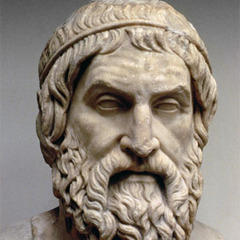
Sophocles
Sophocles

Sophocles, born in 498 BC and died in 406 BC, was a renowned Greek tragic playwright. He is one of the three greatest tragic poets of ancient Greece, alongside Aeschylus and Euripides. Sophocles' works profoundly revealed the complexity of human nature and social contradictions, exerting a profound influence on subsequent drama. more

You May Also Like

“Put shortly, these are the two views, then. One, that man is intrinsically good, spoilt by circumstance; and the other that he is intrinsically limited, but disciplined by order and tradition to something fairly decent. To the one party man's nature is like a well, to the other like a bucket. The view which regards man as a well, a reservoir full of possibilities, I call the romantic; the one which regards him as a very finite and fixed creature, I call the classical. One may note here that the Church has always taken the classical view since the defeat of the Pelagian heresy and the adoption of the sane classical dogma of original sin. It would be a mistake to identify the classical view with that of materialism. On the contrary it is absolutely identical with the normal religious attitude. I should put it in this way: That part of the fixed nature of man is the belief in the Deity. This should be as fixed and true for every man as belief in the existence of matter and in the objective world. It is parallel to appetite, the instinct of sex, and all the other fixed qualities. Now at certain times, by the use of either force or rhetoric, these instincts have been suppressed - in Florence under Savonarola, in Geneva under Calvin, and here under the Roundheads. The inevitable result of such a process is that the repressed instinct bursts out in some abnormal direction. So with religion. By the perverted rhetoric of Rationalism, your natural instincts are suppressed and you are converted into an agnostic. Just as in the case of the other instincts, Nature has her revenge. The instincts that find their right and proper outlet in religion must come out in some other way. You don't believe in a God, so you begin to believe that man is a god. You don't believe in Heaven, so you begin to believe in a heaven on earth. In other words, you get romanticism. The concepts that are right and proper in their own sphere are spread over, and so mess up, falsify and blur the clear outlines of human experience. It is like pouring a pot of treacle over the dinner table. Romanticism then, and this is the best definition I can give of it, is spilt religion.”

“Rubaiyat Revină-n glasul meu persanul vers Spre a ne aminti că timpul-i un divers Mod de-a urzi avide visuri vane, În taine risipite-n univers. Din nou să spună că țărână-i focul, Țărână-i trupul, și că asta-i jocul: Viața mea și-a ta sunt râu ce curge Necontenit și repede-n tot locul. Și că impunătorul monument Zidit cu trudă, din trufie, lent, Un vânt fugar e numai, că-n lumina Lui Dumnezeu un veac e un moment. ... Te rog, persană lună, să revii, Și voi, incerte-apusuri aurii. Azi e ieri. Nu ește decât ceilalți. Tărână-i chipul lor. Cu morții-învii.”

“The shortness of High Renaissance is typical of the fate of all the periods of classical style in modern times; since the end of feudalism the epochs of stability have been nothing but short episodes. The rigorous formalism of the High Renaissance has certainly remained a constant temptation for later generations, but, apart from short, mostly sophisticated, and educationally inspired movements, it has never prevailed again. On the other hand, it has proved to be the most important undercurrent in modern art; for even though the strictly formalistic style, based on the typical and the normative, was unable to hold its own against the fundamental naturalism of the modern age, nevertheless, after the Renaissance, a return to the incoherent, cumulative, co-ordinating formal methods of the Middle Ages was no longer possible. Since the Renaissance we think of a work of painting or sculpture as a concentrated picture of reality seen from a single and uniform point of view - a formal structure that arises from the tension between the wide world and the undivided subject opposed to the world. This polarity between art and the world was mitigated from time to time, but never again abolished. It represents the real inheritance of Renaissance.”

“It is not an overstatement to say that the destiny of the entire human race depends on what is going on in America today. This is a staggering reality to the rest of the world; they must feel like passengers in a supersonic jetliner who are forced to watch helplessly while a passel of drunks, hypes, freaks, and madmen fight for the controls and the pilot's seat. – Eldridge Cleaver, Soul on Ice, 1968”